Inhalt
What a pre-charge resistor actually does
On any traction-class EV, plug-in hybrid or stationary battery-energy-storage system (BESS), the high-voltage DC bus feeds a bank of bulk capacitors inside the inverter, on-board charger, DC-DC converter and sometimes the auxiliary heater. Those capacitors sit at zero volts when the vehicle is sleeping. The instant the main contactor closes, the battery — which can sit anywhere between 350 V on a small commuter pack and 920 V on the latest 800 V architectures — is asked to dump enough charge to bring that capacitor bank from 0 V to within a few percent of pack voltage in essentially no time at all.
The physics is unforgiving. Treat the loop as an ideal voltage source feeding a near-zero-impedance capacitor and the inrush current is bounded only by the parasitic resistance of the bus-bar, the contactor and the cable: typically 5 to 20 mΩ total. On an 800 V pack with 1 000 µF of DC-link capacitance and 10 mΩ of loop resistance, the peak inrush is I_peak = V / R = 80 000 A. Real contactors and cables saturate long before they reach that number, but actual peaks of 2 000 A to 7 000 A for sub-millisecond windows are routine on an unprotected close. That spike is what welds main contactor tips, blows pyro fuses, and on a bad day ages the cell-to-cell bus-bars enough to drift their resistance and heat up in service.
The pre-charge resistor is the mitigation. Wired in series with a smaller, lower-rated pre-charge contactor that is mechanically and electrically separate from the main positive contactor, it forms a deliberate RC charging path. The BMS or vehicle control unit closes the negative main contactor first to reference the bus to ground, then closes the pre-charge contactor. The DC-link capacitor charges through the resistor with a time constant τ = R × C; once the BMS detects that the bus voltage has reached roughly 90 to 95 percent of pack voltage, the main positive contactor closes onto a near-zero voltage differential. Inrush at the main contactor drops from kiloamps into the tens of amps.
Skip the pre-charge resistor and three things happen, in order. First, the main contactor tips arc, micro-weld, and either fail closed (the worst outcome — the high-voltage system can no longer be safed) or accumulate pitting that degrades their current rating over a few hundred cycles. Second, the pyro disconnect or melting-link fuse upstream sees a current pulse close to its breaking capacity and its quality of clearance starts to drift. Third, the cells immediately downstream of the contactor see a voltage transient that the BMS may interpret as an over-current fault, generating a DTC and putting the vehicle into limp-home mode. None of these are theoretical. Sensata's pre-charge whitepaper documents real-world contactor weld-failure rates on systems where a pre-charge resistor was either missing or undersized.
The sizing formula (with worked example)
Six numbers fully describe a pre-charge resistor: nominal pack voltage V_pack, total downstream capacitance C_bus, target charge time to a stated percentage of pack voltage, peak energy dissipated per close event, peak instantaneous power, and the close-cycle frequency over which the element has to cool back to ambient. Calculate them in this order.
Step 1: Pick a target charge time
A typical EV traction inverter wants the bus pre-charged to 95 percent of pack voltage in 100 to 400 ms. Below 100 ms the resistor is asked to dump too much energy and gets physically large; above 400 ms the BMS state-machine starts to feel sluggish to the driver during a key-on, and stationary BESS commissioning teams complain about handshake timeouts with the inverter. The Texas Instruments application note SDAA145 on DC-link pre-charge explicitly recommends staying under 400 ms for compatibility with most Tier-1 inverter handshake protocols.
For an RC circuit the bus voltage follows V_bus(t) = V_pack × (1 − e^(−t/RC)). To reach 95 percent the system needs 3 × τ; to reach 99 percent it needs ~5 × τ. Most BMS firmware uses 95 percent as the close-main-contactor threshold, so you size to R × C = t_target / 3.
Step 2: Solve for R
Given C_bus and a target t_target:
R = t_target / (3 × C_bus)
Step 3: Verify peak energy
Total energy delivered into the capacitor during one close event is E_cap = ½ × C × V². By a conservation argument (and provided the resistor stays in the linear region throughout the charge), anequal amount of energy is dissipated in the resistor, regardless of its value:
E_resistor = ½ × C_bus × V_pack²
That is the single most counter-intuitive result in pre-charge design. A larger resistor charges more slowly, but it dissipates exactly the same total joules per close event as a smaller one. The element therefore has to absorb that energy adiabatically — its thermal mass must be large enough that the brief temperature rise stays below the manufacturer's short-time overload limit.
Step 4: Verify peak power
Initial peak power is P_peak = V_pack² / R, which falls exponentially as the cap charges. The element sees this peak for less than one time constant, so a 5 W cement resistor can survive a 50 kW peak — but only if its joule rating covers the integrated energy.
Step 5: Verify cool-down per close cycle
Average dissipation across a key-on cycle is P_avg = E_resistor / t_cycle, where t_cycle is the minimum interval between two consecutive close attempts (BMS protection logic usually enforces 1 to 5 s). A small element heated to 200 °C in 200 ms must cool back below 80 °C before the next attempt or the temperature ratchets upward.
Worked example A: 800 V passenger EV traction inverter
A 400 kW dual-motor traction inverter on an 800 V pack carries 1 200 µF of DC-link capacitance (SiC inverter, lower ripple than IGBT). Target pre-charge to 95 percent in 200 ms. Pack nominal 750 V, fully charged 920 V.
- R: 0.2 / (3 × 1.2 mF) = 55 Ω. Round to standard 56 Ω.
- E per close (worst case at 920 V): 0.5 × 1200 µF × 920² = 508 J.
- Peak power: 920² / 56 = 15.1 kW (instantaneous, falls to zero over ~3τ = 200 ms).
- Voltage rating: resistor must withstand 920 V DC across its terminals; specify 1 200 V working minimum to cover transient over-voltages.
- Average power, 5 closes per minute key-cycling: 508 × 5 / 60 = 42 W average. A 100 W cement element with 600 J single-pulse rating is the practical pick.
Worked example B: 250 kW stationary BESS PCS
A 250 kW grid-scale energy-storage power-conversion system at 1 000 V DC. Combined DC-link capacitance across two parallel inverter banks: 4 700 µF. Target 350 ms to 95 percent.
- R: 0.35 / (3 × 4.7 mF) = 24.8 Ω. Pick 25 Ω.
- E per close: 0.5 × 4700 µF × 1000² = 2 350 J.
- Peak power: 1000² / 25 = 40 kW.
- Voltage rating: 1 500 V working minimum.
- Selection: two 50 Ω / 300 W tubular wirewound elements in parallel, each rated for 1 500 J pulse energy. Total element mass roughly 800 g — adiabatic temperature rise of about 65 °C per close, well inside derating.
Pulse energy vs continuous power — why a 5 W resistor swallows 100 J
Procurement teams new to pre-charge applications routinely look at a 5 W rating, do the maths on the worked example above (508 J in 200 ms = 2.5 kW average), and conclude that a 5 W resistor cannot possibly do the job. The mistake is treating the continuous power rating as the limit. For single-pulse events shorter than the element's thermal time constant, the energy-to-failure scales with the thermal mass of the resistive element, not with its steady-state heat-shedding ability.
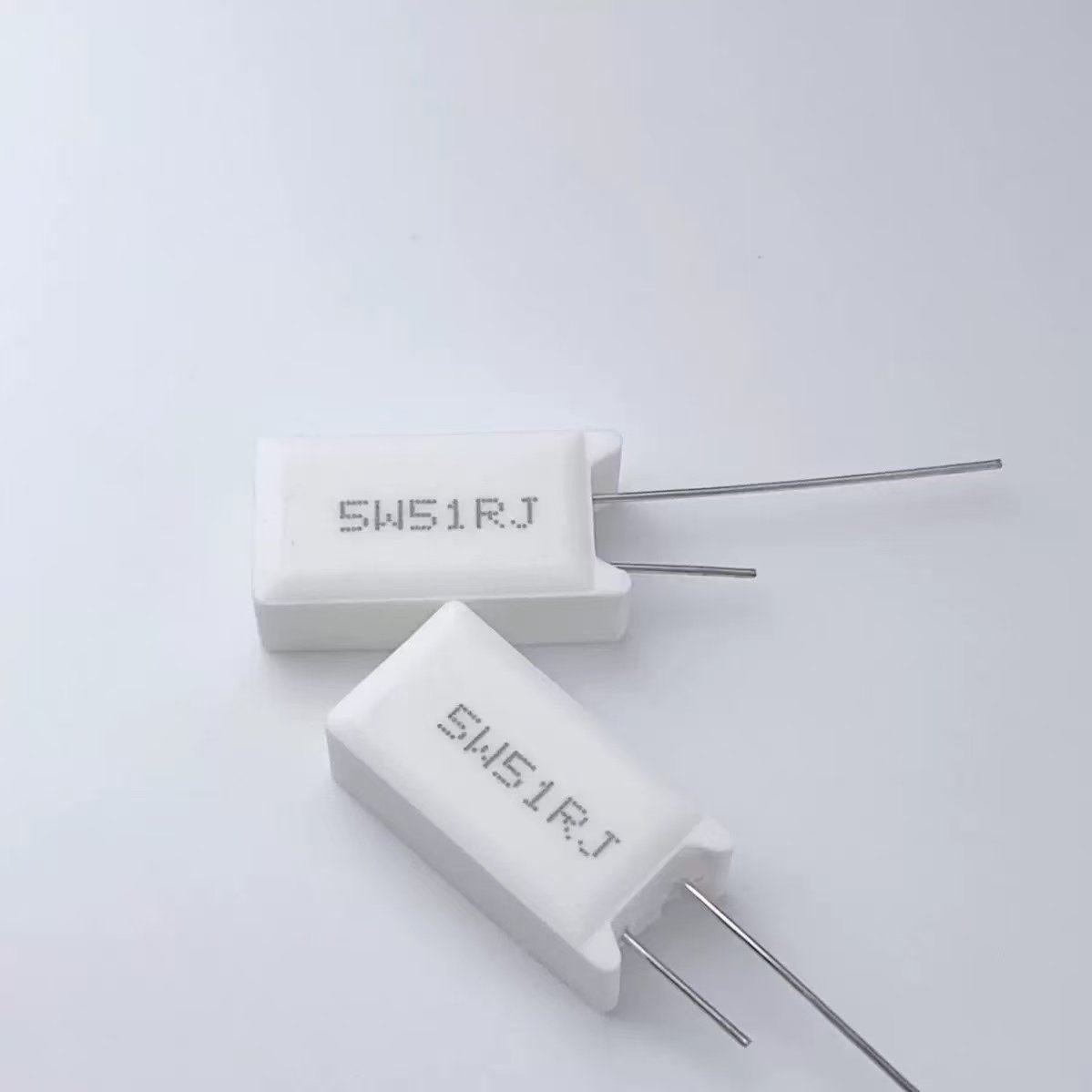
The physics is straightforward. A 5 W cement resistor contains roughly 0.5 to 1 g of nichrome wire potted in 8 to 10 g of cement. Specific heat of nichrome is around 0.45 J/(g·K); specific heat of ceramic cement is around 0.85 J/(g·K). For the wire alone, a 100 J pulse delivered in less than one thermal time constant raises its temperature by ΔT = 100 / (1 × 0.45) = 222 °C. The cement surrounds the wire and acts as a heatsink on the millisecond-to-second timescale, so the actual hot-spot rise is closer to 100 to 150 °C — well inside the element's short-time overload spec, even though the average dissipation rate during the pulse (100 J / 0.2 s = 500 W) is 100 times the continuous rating. Passive Components Blog publishes a useful set of pulse-derating curves that show this behaviour family-by-family.
The corollary is that you must read the pulse-energy spec, not the continuous power spec. Quality power-resistor datasheets quote three numbers for pulse work: single-pulse energy at 1 s, single-pulse energy at 10 ms, and a repeat-pulse curve giving allowable pulse energy as a function of cycle interval. A datasheet that lists only continuous wattage is unsuitable for pre-charge duty — pick a different supplier.
| Parameter | Carbon film 1 W | Metal film 2 W | Cement 10 W | Wirewound 50 W | Aluminum housed 100 W | Tubular wirewound 300 W |
|---|---|---|---|---|---|---|
| Element mass (g) | 0.3 | 0.4 | 12 | 45 | 80 | 350 |
| Single-pulse energy at 100 ms (J) | 0.5 | 1.0 | 120 | 550 | 950 | 3 500 |
| Single-pulse energy at 1 s (J) | 1 | 2 | 180 | 850 | 1 500 | 5 000 |
| Pulse-to-continuous ratio (energy / W·s) | 0.5× | 0.5× | 12× | 11× | 10× | 12× |
| Voltage withstand (V DC) | 350 | 500 | 1 000 | 1 500 | 1 500 | 2 500 |
| Suitability for 800 V EV pre-charge | No | No | Marginal — small packs only | Yes — passenger car class | Yes — preferred | Yes — large BESS |
| Typical unit cost (USD) | 0.05 | 0.10 | 0.40 | 2.50 | 6.00 | 18.00 |
Reading across the rows, a few patterns jump out. Carbon film and metal film at their normal 1 to 2 W ratings are useless for pre-charge work above 100 V DC packs — the element mass is too low to absorb the energy and the glassivation cracks before the cap is half charged. Cement is borderline at 800 V class and only works for pack capacitance under about 250 µF. Wirewound, especially in cement-encased or aluminum-housed variants, is the sweet spot for 400 to 800 V passenger vehicles. Tubular wirewound dominates above 1 000 V and into the BESS range.
Cement vs wirewound vs film for pre-charge — head-to-head
Once the application is in the 400 V to 1 500 V band that covers most modern EV and BESS hardware, the genuine candidates narrow to three families: cement-encased wirewound (typical of Hongyi's SQP-style horizontal and vertical parts), aluminum-housed wirewound (gold-anodised heatsink-mount parts), and chassis-mount tubular wirewound. We sometimes see proposals for thick-film high-voltage parts and we routinely turn them down — film parts simply do not have the thermal mass for repeated 500 J pulses.
| Parameter | Cement encased (SQP) | Aluminum housed | Tubular wirewound | Thick-film HV |
|---|---|---|---|---|
| Typical R range for pre-charge | 10 Ω – 200 Ω | 20 Ω – 500 Ω | 10 Ω – 1 kΩ | 1 kΩ – 50 kΩ |
| Continuous power range | 3 – 25 W | 25 – 300 W | 50 – 1 500 W | 1 – 20 W |
| Single-pulse energy (J / unit) | 50 – 250 | 300 – 1 500 | 800 – 5 000 | 5 – 30 |
| DC voltage withstand | 1 000 V | 1 500 V | 2 500 V | 3 000 – 10 000 V |
| TCR (ppm/°C) | ±300 | ±300 | ±200 | ±100 |
| Mounting | PCB through-hole or chassis bracket | M3/M4 stud to heatsink | M5/M6 stud to chassis | PCB SMD or radial |
| Mass per typical part (g) | 12 – 40 | 60 – 250 | 200 – 900 | 0.5 – 3 |
| Vibration rating per IEC 60068-2-6 | 20 g, 10–500 Hz | 30 g, 10–2 000 Hz | 30 g, 10–2 000 Hz | 20 g, 10–500 Hz |
| AEC-Q200 availability | Yes | Yes | Limited | Yes |
| Failure mode under abuse | Crack open, no flame | Crack open, no flame | Wire fuses open, no flame | Substrate fracture, may carbonise |
| Cost per joule of pulse capacity | Best for small EV | Best for passenger EV | Best for BESS | Worst (3–10× wirewound) |
| Hongyi recommended series | SQP cement vertical / horizontal | Gold-anodised aluminum housed | RX21 tubular | Not recommended for pre-charge |
Two non-obvious notes from the table. First, thick-film HV parts have great voltage withstand but trivial pulse energy capacity — they are the wrong family here, despite their high voltage rating. Second, AEC-Q200 availability matters for vehicles. AEC-Q200 stresses parts to defined humidity, thermal-shock, ESD, mechanical-shock and temperature-cycling profiles; without that screening the part may pass the bench test and fail in service after two winters. Hongyi AEC-Q200-stressed parts are tested per the AEC Q200 component qualification specification.
Failure modes — what kills a pre-charge resistor in the field
Across about three years of warranty returns from Tier-1 EV programs and BESS integrators, four failure mechanisms account for nearly every pre-charge resistor that has come back to our application lab. None of them are exotic. All of them are designed-out by following the sizing rules above and the checklist at the end of this article.
1. Open-circuit from cumulative thermal fatigue (most common)
Each pre-charge event heats the wire by roughly 50 to 200 °C in milliseconds, then the wire cools back to ambient over the next few seconds. That thermal pulse stretches the wire microscopically, which work-hardens the alloy over thousands of cycles. The wire eventually snaps at its hottest point. We see this at 5 000 to 50 000 cumulative pre-charge events on undersized parts, against a design target of 100 000 +. Solution: derate, and verify against IEC 60068-2-14 thermal-cycling test profile Na (rapid temperature change).
2. Resistance drift from oxidation
Nichrome wire surface oxidises slowly at room temperature and rapidly above 400 °C. Each pulse takes the hot spot through that threshold; oxidation on the wire surface increases its resistance by 0.1 to 0.3 percent per thousand cycles. After 50 000 events the resistance can have drifted by 5 to 15 percent, slowing the charge time and causing the BMS to time out before the bus reaches the close threshold. This mode is invisible until the vehicle goes into limp mode without an obvious DTC. Mitigation: properly potted (sealed) cement housing or aluminum housing, and a tighter tolerance class (use ±5 percent or better and add a 20 percent margin to target charge time).
3. Cement cracking from repeated thermal stress
The wire is hot, the cement that surrounds it is cold. The differential expansion at the wire-cement interface is small per pulse but cumulative. Cracks initiate at the crimp where the lead exits the cement, propagate along the wire, and can reach the outer surface as visible hairlines after 10 000 to 30 000 cycles. Once cracked, the part is not yet electrically open but moisture ingress accelerates wire oxidation and the part fails open within months. We have inspected returned parts where the original crack is clearly visible and a finger-nail can lift the cement free of the wire. Mitigation: select cement-housing grade matched to IEC 60068 climatic categories that include the vehicle's storage environment.
4. Solder-joint fatigue at the lead
The lead-frame to PCB solder joint sees not the pulse temperature but the board-level temperature swing. EV packs go from −40 °C cold-soak to +85 °C summer to +120 °C local heating during fast charge. Tin-lead-free solder fatigues quickly under that profile if the resistor body is rigid (cement) and the PCB flexes. Returned parts show ring-cracks around the lead. Mitigation: relieve mechanical stress by adding a service loop in the lead, or specify a chassis-mount aluminum-housed part that is mechanically isolated from the PCB.
Sizing flow — from one-line spec to part number
Use the flow below as a checklist. Every step has a measurable output that the downstream step depends on; if you cannot answer one, go back and resolve it before continuing. We have seen far too many pre-charge designs where step 6 was answered last and the resistor turned out to be physically too large to fit the junction box.
One pragmatic shortcut: most passenger-EV pre-charge designs land within a band of 40 to 80 Ω, 50 to 200 W continuous, 500 to 1 500 J pulse capacity. If your back-of-envelope sizing falls a long way outside that band (very low resistance below 10 Ω, or very high above 500 Ω), re-check the input numbers — odds are the capacitance estimate or the target charge time is off.
Hongyi product recommendations by application class
Three Hongyi product families cover the practical envelope for EV traction, on-board charging, DC fast-charging and BESS pre-charge work. They share a common Cu-Mn-Ni or Ni-Cr resistance-wire core, an inorganic potting compound rated to 250 °C continuous, and AEC-Q200 stress-screened lots on request.
Small passenger EV / two-wheeler / 48 V – 400 V packs
For DC-link capacitance below about 800 µF and pack voltages up to 400 V, a cement-encased SQP-style part is the right answer. Hongyi's cement resistor catalogue covers 5 W to 50 W in horizontal and vertical packages. Typical pre-charge selection: 33 to 100 Ω, 25 W cement-encased, with tinned-copper leads sized to the application's solder-joint thermal cycle.
Passenger EV traction inverter, 400 V – 800 V class
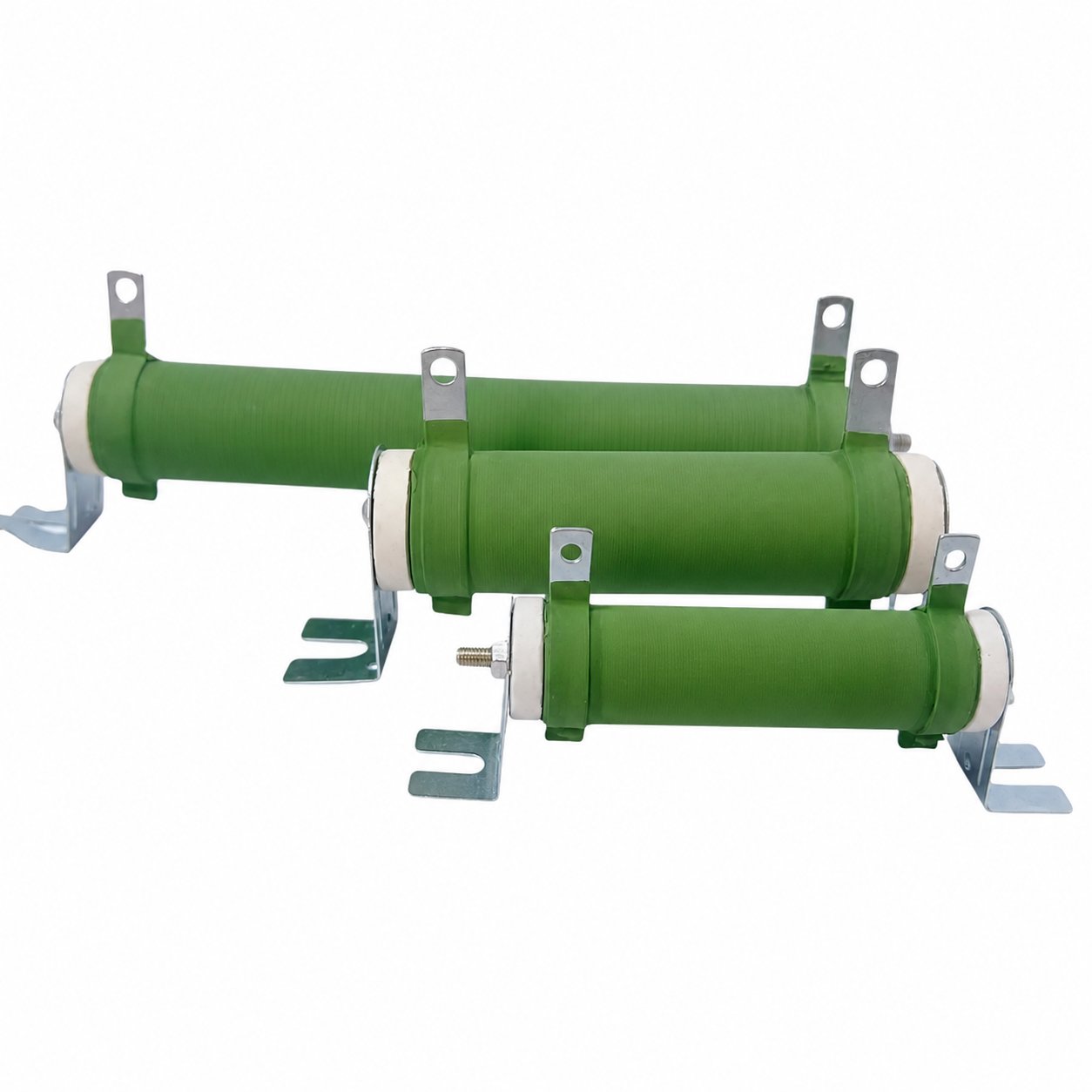
The mainstream traction-class application — 800 to 1 500 µF DC-link, 400 to 1 000 ms charge target, 500 to 1 500 J per close — is best served by aluminum-housed wirewound. Hongyi's aluminum housed series covers 25 W to 300 W with M3 or M4 stud mounting onto a heatsink or cold-plate. The aluminum body provides excellent pulse handling because the shell pulls heat off the resistance wire on the millisecond timescale and then continues to dissipate via convection. Typical pre-charge selection: 50 to 80 Ω, 100 W aluminum housed, 1 500 V working voltage option.
Heavy-duty EV, BESS PCS, DC fast-charging dispenser
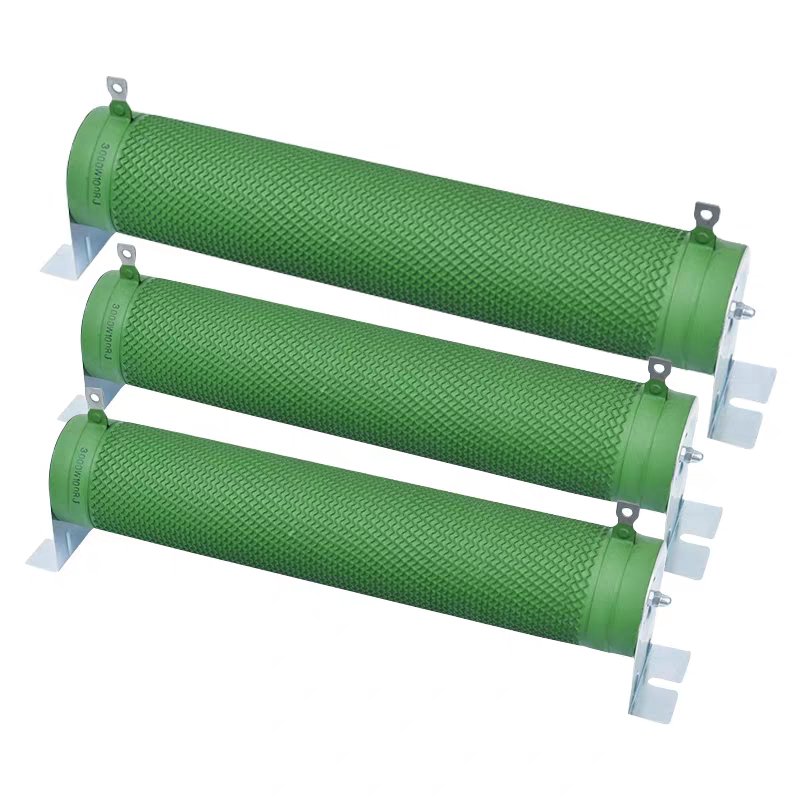
For larger systems — 2 000 µF and up of DC-link, 1 000 V and above — chassis-mount tubular wirewound is the workhorse. Hongyi's wirewound power resistor series covers 50 W to 1 500 W per element with vitreous-enamel coating and stud mounts. For BESS pre-charge it is common to parallel two or three elements both for redundancy and to spread the pulse energy across more thermal mass. Typical pre-charge selection: two parallel 50 Ω / 300 W tubular elements, 2 000 to 2 500 V working voltage.
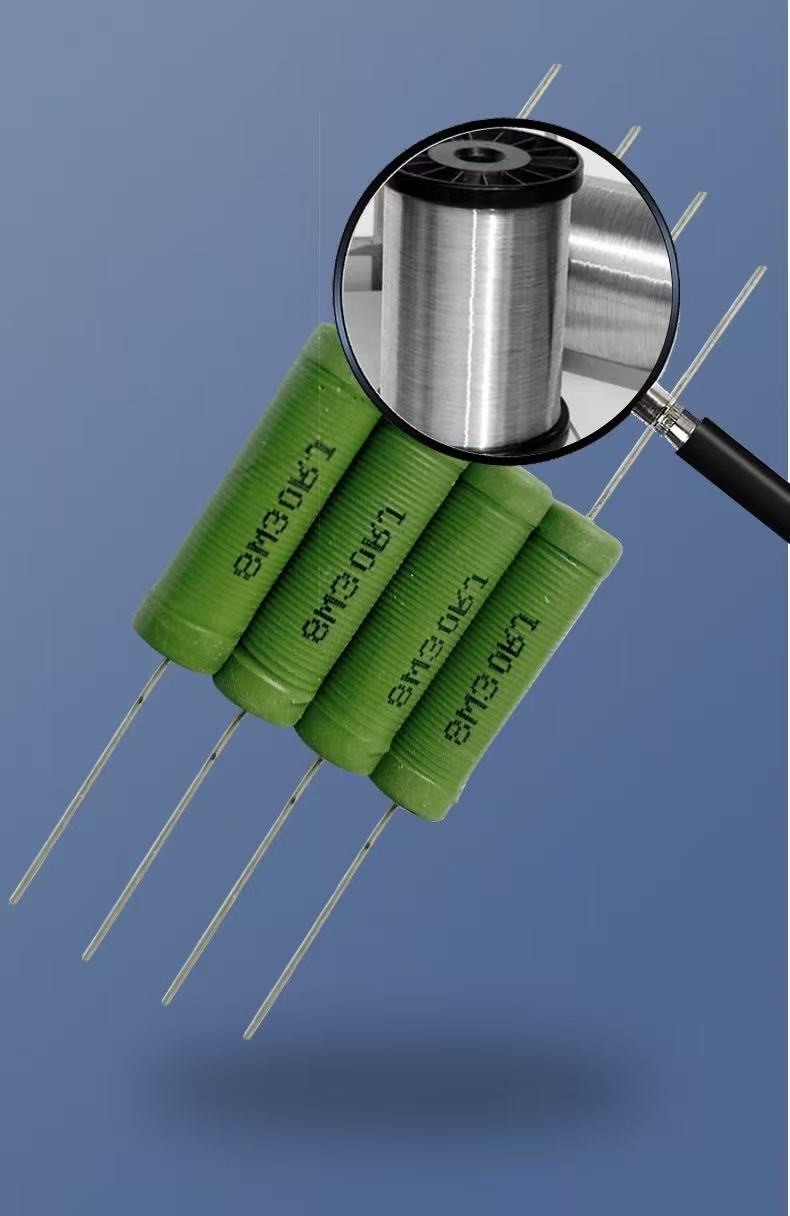
On every class, AEC-Q200 stress screening, IEC 60115-1 climatic-category testing and lot-traceable resistance/voltage withstand records are available on request. For vehicle programs we recommend specifying the AEC-Q200 grade up front; the unit cost premium is small (typically 5 to 10 percent) compared to the eventual cost of a field campaign.
Final selection checklist
Use this list before placing the production order. If two or more answers are missing, the design is not ready.
Electrical
- Pack nominal voltage, maximum charge-end voltage, and minimum cold-soak voltage all documented.
- Total downstream capacitance summed across DC-link of inverter, OBC, DCDC, HVAC heater, with film-cap aging margin (+20 percent).
- Target charge time agreed with BMS firmware team (typically 100 to 400 ms to 95 percent).
- Calculated
Rrounded to a standard E12 value within ±10 percent of theoretical. - Pulse energy
E = ½ C V_max²calculated, with resistor pulse-energy spec at least 1.3 × that figure. - Resistor working voltage at least
1.3 × V_max. - Tolerance class ±5 percent or better; TCR ±200 ppm/°C or better for vehicle use.
Thermal and mechanical
- BMS retry interval set to at least 5 × the resistor's thermal time constant (typically 5 to 30 s for cement / aluminum housed).
- Ambient temperature envelope including worst-case junction-box internal temperature (often 90 to 105 °C in summer for under-floor packs).
- Mounting orientation, bracket and torque spec documented. For aluminum housed parts, specify thermal interface material and torque per supplier datasheet.
- Vibration profile to IEC 60068-2-6 and shock to IEC 60068-2-27 confirmed against vehicle test plan, or to IEC 62506 for BESS shipping.
- Clearance and creepage from resistor terminals to chassis ground meets the isolation-resistance requirement of ISO 6469-3.
Compliance and documentation
- AEC-Q200 stress-screening report on file (vehicle programs).
- IEC 60115-1 climatic category and stability class declared, with test report (BESS programs).
- ISO 26262 functional-safety analysis identifies the pre-charge resistor as either an ASIL B or ASIL C item (see vehicle DFMEA).
- Lot traceability — DC resistance and dielectric withstand records per shipping lot.
- RoHS 3, REACH SVHC, and (where applicable) China RoHS / IMDS material declarations issued within the last 12 months.
Commercial
- Lead time for AEC-Q200 stress-screened lots is typically 6 to 10 weeks longer than standard catalogue. Plan accordingly.
- Spares strategy: hold one spare per ten installed for vehicle service; for BESS hold two spares per PCS string.
- Cost-of-failure analysis on file. A welded main contactor traced back to a failed pre-charge resistor is typically a five-figure repair on a vehicle and a six-figure outage on a grid-scale BESS. Spec accordingly.
Häufig gestellte Fragen
Welchen Vorladewiderstandswert sollte ich für ein 800-V-EV wählen?
Warum überlebt ein 5-W-Zementwiderstand einen 100-J-Puls?
Wie lange sollte der Vorladevorgang dauern?
Zement, Aluminium-Gehäuse oder drahtgewickelt — welche Familie ist richtig?
Brauche ich AEC-Q200-Stress-Screening?
Was ist die häufigste Ausfallart bei Vorladewiderständen?
Quellen & weiterführende Literatur
- ISO 6469-3:2021 — Electrically propelled road vehicles, electrical safety
- TI SDAA145 — DC-Link Capacitor Pre-Charge Designs in Automotive Systems
- Sensata — How to design pre-charge circuits for EVs (whitepaper)
- AEC-Q200 — Stress test qualification for passive components
- IEC 60115-1 — Fixed resistors for use in electronic equipment
- IEC 60068-2-14 — Environmental testing: thermal cycling Na
- Battery Design — Pre-charge resistor primer