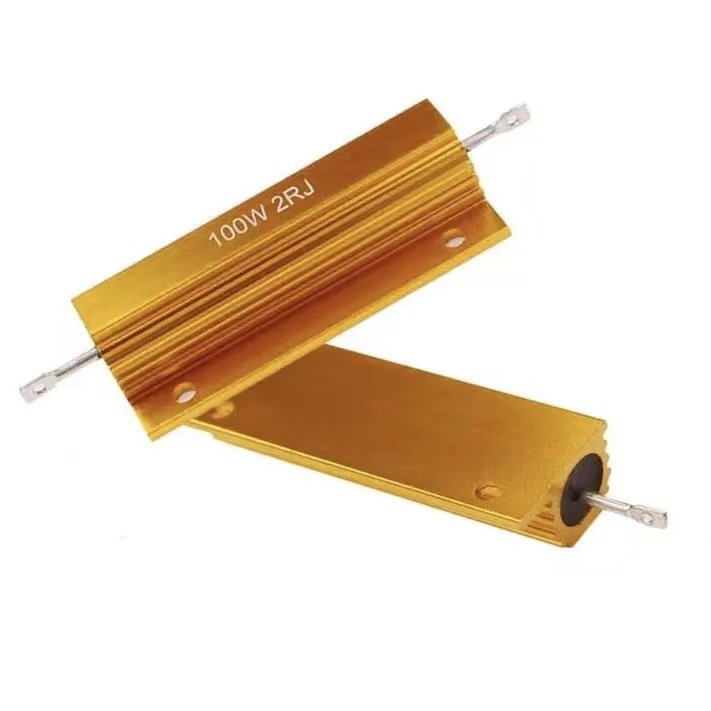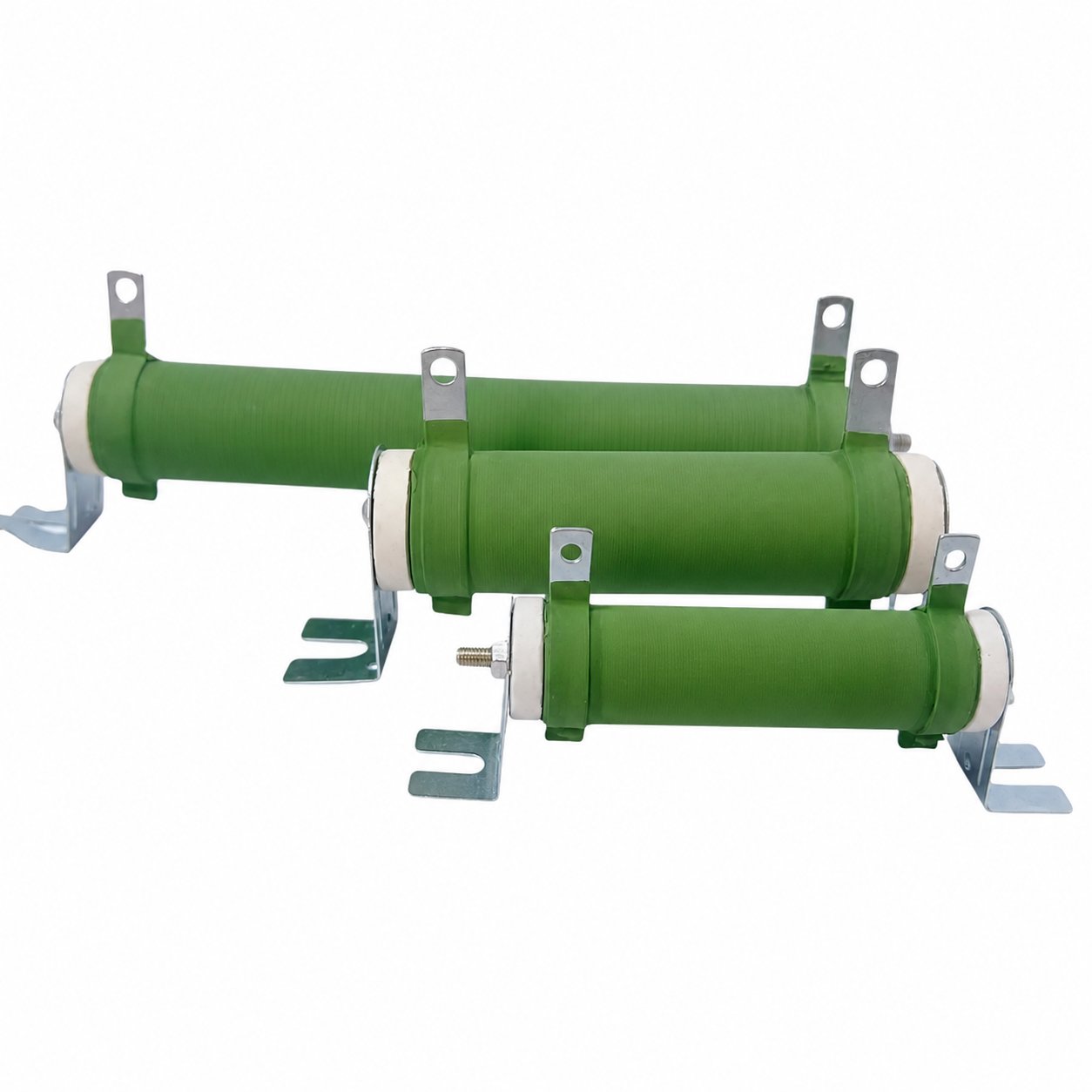
Inhalt
What a braking resistor actually does
A braking resistor is a passive heat sink for kinetic energy. When a variable-frequency drive (VFD), servo amplifier or DC link decelerates an inertial load faster than friction and windage alone would allow, the motor flips into generator mode and pumps current back into the DC bus. Capacitors absorb a small fraction of that current. The braking chopper, a high-current IGBT switching at the bus over-voltage threshold (typically 780 V DC on a 400 V AC drive, 380 V DC on a 200 V system), routes the rest into the resistor where it dissipates as heat.
That last sentence carries the whole engineering problem. The resistor has to absorb regenerative energy without exceeding its hot-spot temperature, without drifting in resistance, and without becoming a fire risk inside a control cabinet. Get the value right and the drive trips cleanly on any over-voltage fault while the resistor stays warm to the touch. Get it wrong and you will see one of three failure modes within months: a cracked element from thermal fatigue, a shorted braking IGBT from excessive ripple current, or, in the worst case, an open-circuit resistor that lets the DC bus climb until the drive output stage flashes over.
The applications that actually need an external braking resistor are predictable. High inertia loads (centrifuges, large fans, flywheels), overhauling loads where gravity does the driving (cranes, elevators, hoists, downhill conveyors), short-cycle servo systems (pick-and-place, packaging, indexing tables), and fast e-stop requirements in safety-rated stops are the four big buckets. Pumps, mixers and light-duty conveyors rarely need one because their natural friction absorbs the deceleration energy. A decent starting heuristic from ABB Technical Guide No. 8: if your stop time is less than five times the motor mechanical time constant, plan on dynamic braking.
One more conceptual note. A braking resistor is not the same as a load bank, an inrush limiter, or a snubber. Load banks operate continuously at rated power. Inrush limiters see one pulse per power-up. Snubbers handle nanosecond-scale switching transients. Braking resistors see repetitive multi-second pulses at five to twenty times their continuous rating, which is why their derating curves and pulse-energy specs matter more than the steady-state wattage printed on the label.
The sizing formula (with worked example)
Four numbers fully describe a braking resistor: resistance R in ohms, continuous power P_avg in watts, peak pulse energy E_pulse in joules, and the duty cycle the average rating is referenced to. Calculate them in this order.
Step 1: Find the peak braking power
Peak power is set by the worst case deceleration. For a rotating load:
P_peak = (J × (ω_1² - ω_2²)) / (2 × t_decel) × η
where J is total inertia reflected to the motor shaft in kg·m², ω is angular velocity in rad/s, t_decel is deceleration time in seconds, and η is the regeneration efficiency of the motor and drive together (typically 0.85 to 0.95 for modern AC drives). For a linear load with mass m moving at velocity v, substitute (m × v²) / 2.
Step 2: Set the resistance value
The resistance is bounded above by the chopper threshold and below by the maximum chopper current:
R_max = V_brake² / P_peak and R_min = V_brake / I_chopper_max
V_brake is the bus voltage at which the chopper fires (look it up in the drive manual, do not guess). I_chopper_max is the IGBT rating of the brake transistor.KEB's brake-chopper note walks through the IGBT current limits in detail. Pick a standard resistance value between R_min and R_max; if there is no overlap, the drive is undersized.
Step 3: Compute average power
Average power is peak power weighted by the duty cycle:
P_avg = P_peak × (t_decel / t_cycle)
where t_cycle is the period from one braking event to the next. Add a safety factor of 1.25 to 1.5 to cover ambient temperature drift, altitude derating and wire aging.
Worked example: 55 kW elevator drive, 4 s deceleration
A passenger elevator with a counterweight runs on a 55 kW VFD on a 400 V AC supply. The car decelerates from 2.5 m/s to standstill in 4 s, twice per minute during peak traffic. Combined reflected inertia (car, counterweight, sheave, motor) is 2.8 kg·m² at the motor shaft. Motor rated speed is 1500 rpm (157 rad/s). The chopper fires at 780 V DC, IGBT rated at 165 A. Regeneration efficiency 0.90.
- Peak power: P_peak = (2.8 × (157² - 0²)) / (2 × 4) × 0.90 = 7 765 W. Round up to 8 kW peak.
- R_max: 780² / 8000 = 76 Ω. R_min: 780 / 165 = 4.7 Ω. Plenty of room. We pick 15 Ω because it gives a healthy 52 A peak through the IGBT and a real peak power of 780²/15 = 40.5 kW, which lets the chopper fire briefly even on a higher inertia emergency stop.
- Duty cycle: 4 s braking out of a 30 s cycle = 13.3 percent.
- P_avg (continuous): 8000 × 0.133 = 1064 W. Apply a 1.4 safety factor: 1.5 kW continuous rating.
- Peak energy per stop: 0.5 × 2.8 × 157² × 0.90 = 31 kJ. The resistor's pulse-energy spec must exceed this.
Final selection: a 15 Ω, 1.5 kW continuous, 35 kJ pulse corrugated wirewound braking resistor with natural convection. That is roughly a Hongyi RXLG-1500 W trapezoidal element with a single mounting bracket.
Peak vs continuous power — the most common mistake
By a wide margin the most frequent procurement mistake we see is buying a resistor on continuous-power rating alone. A buyer reads "the drive does 55 kW so I need a 55 kW resistor", picks a 15 Ω 55 kW chassis unit, and is then surprised when it costs four times as much as the application actually needs, occupies a rack of cabinet space, and still trips on a fast emergency stop because its peak energy spec is not the bottleneck.
The opposite mistake is equally common and more dangerous. A buyer reads the duty-cycle math, calculates a 1.5 kW average, and orders a 1.5 kW general purpose wirewound with no published pulse-energy spec. The first stop dumps 30 kJ into the element in four seconds. The wire reaches 800 °C internally, the enamel cracks, and within a hundred cycles the resistance has drifted enough to put the IGBT current outside spec.
The fix is to read both numbers on the datasheet. A purpose-built braking resistor will quote three values, not one: continuous power at a stated cooling condition, peak power for a stated pulse duration (commonly 5 s or 10 s), and total pulse energy per cycle. Vishay and other top-tier suppliers publish multi-line tables; lower-tier datasheets sometimes list only continuous power, which is a red flag.
A useful sanity check: peak-to-continuous ratio. Quality braking resistors typically sit between 10:1 and 25:1 (a 1 kW continuous rating with 10 to 25 kW peak). If a datasheet shows a ratio under 5:1 the part is a general-purpose power resistor mislabelled, and if the ratio is over 50:1 the continuous rating is probably optimistic.
Cooling options: natural / forced-air / water
Cooling sets the entire enclosure design, so this decision often happens before the resistance value is finalized. Three options cover 99 percent of industrial drives: natural convection, forced air, and water cooling.
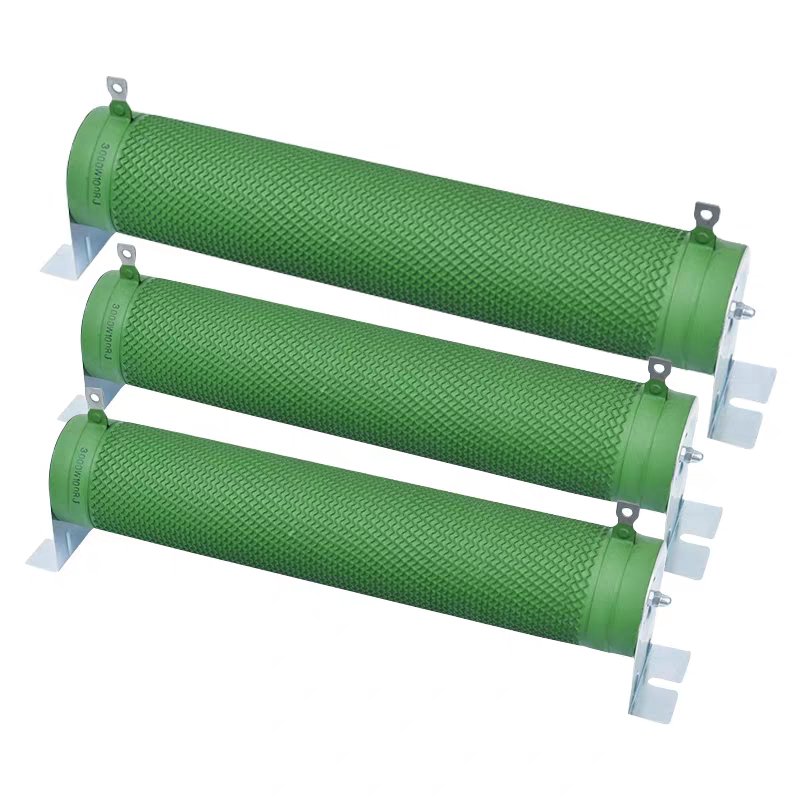
Natural convection is the default for everything up to roughly 5 kW continuous. Vertical mounting, 100 mm clearance above and below, no enclosure obstructions. Corrugated wirewound elements (the classic ribbed-tube look) dominate this range because the surface area scales linearly with element length. Hongyi's RXLG trapezoidal series covers 50 W to 1500 W per element with naturally cooled continuous ratings, and parallel-bracketed assemblies extend that to about 6 kW per enclosure before forced air becomes more cost-effective.
Forced-air cooling adds a fan and an airflow plenum. Continuous ratings jump 2 to 3 times for the same element. Crucially, the fan must be temperature-switched or continuously running, not interlocked to the brake signal, because thermal mass means the element keeps getting hotter for several seconds after braking ends.Cressall's catalogue is a good reference for typical forced-air-cooled assembly sizes from 5 kW to 200 kW.
Water cooling shows up above 100 kW continuous, in EV fast-charging dumps, in rail traction, and in marine drives where ambient air is salty and dirty. The resistor element sits inside a stainless or aluminum jacket; deionised water or glycol mix flows through at 5 to 20 L/min. Power density reaches 50 W per cubic centimetre, an order of magnitude better than forced air. The downsides are obvious: a pump, a chiller, leak protection, conductivity monitoring for deionised water, and freeze protection for outdoor installs.
| Parameter | Natural convection | Forced air | Water cooled |
|---|---|---|---|
| Typical power range | 50 W to 6 kW | 5 kW to 200 kW | 100 kW to several MW |
| Power density | 0.5 W/cm³ | 2 to 5 W/cm³ | 20 to 50 W/cm³ |
| Footprint per kW | Large | Medium | Small |
| Auxiliary equipment | None | Fan, thermal switch | Pump, chiller, leak detector |
| Maintenance | Visual inspection annually | Replace fan every 3 to 5 years | Filter, fluid quality, pump seals |
| Capex per kW | Lowest | Roughly 1.5 to 2x | 3 to 5x |
| Best for | VFD up to 75 kW, servos | Industrial drives 75 to 1000 kW | EV charging dump, traction, marine |
| Failure-tolerant | Yes — passive | Degrades gracefully if fan fails (thermal switch) | Hard fail if coolant lost |
Two warnings that catch people out. First, derating curves are usually drawn for free air at sea level with the element mounted in its standard orientation. Mount a corrugated element horizontally on a hot panel and the natural-convection rating drops by 30 to 50 percent. Second, the difference between IP00 (open construction, highest dissipation) and IP54 (sealed enclosure, lowest dissipation) is roughly a factor of three. Specify the protection rating up front; ordering an IP54 unit and then realizing later that it cannot pull anywhere near its nameplate is a common procurement failure.
Duty cycle and derating curves
Duty cycle, often labelled ED (Einschaltdauer) on European datasheets, is the percentage of any rolling 120-second window during which the resistor is dissipating power. ED 6 percent, ED 25 percent and ED 60 percent are the three values you will see most often. A 25 kW resistor rated at ED 25 percent means it can handle 25 kW averaged over any rolling two-minute window with 75 percent of that window in zero-power cooldown.
The derating curve translates one duty cycle into another. A typical wirewound element looks like this when you read it carefully:
| Parameter | ED 100% (continuous) | ED 60% | ED 25% | ED 10% | ED 6% |
|---|---|---|---|---|---|
| Power multiplier | 1.0x | 1.4x | 2.2x | 3.5x | 5.0x |
| Example: 5 kW base rating | 5 kW | 7 kW | 11 kW | 17.5 kW | 25 kW |
| Typical use case | Load bank, dump load | Heavy hoisting | VFD braking | Servo motion | Emergency stop only |
| Reference period | — | 120 s | 120 s | 120 s | 120 s |
Use derating curves carefully. Two pitfalls. First, the multiplier always references a fixed window (120 s on European data, sometimes 60 s on US data). If your braking cycle is longer than the reference, you are off the curve and have to compute from pulse-energy specs instead. Second, the curve assumes the resistor cools all the way back to ambient between pulses. In a hot cabinet with poor airflow, "ambient" is 50 °C plus, and the curve no longer applies.KOA's derating-curve primer covers the temperature corrections.
Ambient derating itself is roughly linear above 40 °C. A part rated for 100 percent at 40 °C ambient typically drops to 80 percent at 70 °C and 50 percent at 100 °C. Altitude derating starts at 1000 m and runs at about 5 percent per 1000 m extra elevation. Cabinet-mounted resistors in enclosed control rooms in subtropical climates routinely operate at 70 to 80 percent of nameplate, which is why the 1.25 to 1.5 safety factor in the sizing step is not paranoia.
IEC 60322 and other standards
IEC 60322 is the dominant international standard for power resistors of open construction used on rolling stock. It started life as a railway document but its test methods (dielectric strength, surface temperature, vibration, salt-spray, short-time overload) have been adopted across industrial drives as well. If you export to Europe, Japan, South Korea, Australia or any market that follows IEC harmonisation, IEC 60322 compliance signals that the supplier knows what they are doing. The standard itself is available through the IEC web store, and a corresponding national version exists in most major markets (BS EN 60322, GB/T 32347).
For railway use, IEC 60322 sits inside a stack. IEC 60077-1 covers general electrical equipment for rolling stock. EN 50124 governs insulation coordination for railway applications, and EN 50155 covers electronic equipment generally. Together they imply temperature class, dielectric strength, creepage and clearance distances, and fire-smoke-toxicity (EN 45545) requirements that an industrial-grade braking resistor will not meet without being specifically engineered for it.
Outside railway, the relevant standards depend on application:
- IEC 60115 — general fixed resistors. Establishes how power ratings, climatic categories and stability classes are tested. Industrial drives typically reference this for the base resistor element.
- UL 1412 — fusing resistors and other components, used in North-American panels where the resistor doubles as a current-limit during fault.
- IEEE Std 1100 — recommended practice for powering electronic equipment, useful as a reference for grounding and EMC of braking-resistor installations. IEEE store entry.
- CE Low Voltage Directive 2014/35/EU — required for any installation in the EEA. Resistor must be CE marked or be a sub-component declared compliant by the panel builder.
- RoHS 3 (EU 2015/863) and REACH SVHC — substance restrictions. Verify the porcelain cement and any wire coatings are compliant, especially for cement-bodied parts where lead-bearing glaze has historically been a problem.
- UN 38.3 / DOT-39 — only if the resistor is part of a battery pack shipment (rare).
Final selection checklist
Use the following as a procurement-ready checklist. Each item maps to a question a drive engineer or buyer should be able to answer before placing the order. If two or more answers are missing, do not place the order yet.
Electrical
- Drive nominal AC voltage and DC bus over-voltage threshold (e.g. 400 V AC / 780 V DC).
- Brake-chopper IGBT rated current (sets R_min).
- Peak braking power calculated from inertia and deceleration profile.
- Resistance value selected between R_min and R_max, with at least 20 percent margin to both bounds.
- Continuous power including 1.25 to 1.5 safety factor.
- Peak energy per cycle (joules) and worst-case single-event energy.
- Tolerance class — 5 percent is standard, 10 percent is acceptable for braking, do not pay for 1 percent.
Thermal and mechanical
- Cooling method (natural / forced air / water) and confirmed footprint inside the cabinet or enclosure.
- Ambient temperature including worst-case cabinet rise. State both nominal and maximum.
- Altitude of installation site.
- Mounting orientation. Horizontal mounting often costs 20 to 30 percent of rated power.
- IP rating of the resistor enclosure (IP00, IP20, IP54, IP66). Match to the cabinet, not to the room.
- Required clearance distances and creepage for the operating voltage.
Compliance and documentation
- IEC 60322 or IEC 60115 conformity declaration on file.
- CE mark for EU shipments; UL recognition for North America if required by the AHJ.
- RoHS / REACH declarations recent (within 24 months).
- Material declaration for fire-rated installations (EN 45545 for rail, NFPA 130 for transit).
- Factory test certificate per unit if the application is safety-critical (elevators per EN 81-20, cranes per EN 13135).
Commercial
- Lead time. Standard catalogue items: 2 to 4 weeks. Custom resistance values: 4 to 8 weeks. Custom enclosures with cooling: 8 to 14 weeks. Plan the procurement window accordingly.
- MOQ. Most reputable factories will sample one to five units; series production typically starts at 10 to 50 units depending on size.
- Cost driver visibility. For wirewound, resistance alloy (Nichrome 80/20 vs Cu-Ni) and wire diameter dominate; for aluminum housed, the extrusion tooling dominates at low volumes.
- Custom mounting hardware (DIN-rail brackets, panel-mount feet, banding) ordered together or separately?
- Spares strategy. For 24/7 production lines, hold one spare per ten installed and rotate.
- Warranty terms. 12 months from delivery is standard. Some suppliers will offer 24 months on properly derated units.
For an authoritative deep-dive into chopper sizing and braking topologies including regenerative-front-end alternatives, the Siemens SINAMICS braking-resistor guide covers the application engineering across their entire drive line, and is a useful cross-reference even if you are commissioning on another drive family. For an eye-opening reliability case study, the EEPower resistor guide walks through several real failure analyses.
Häufig gestellte Fragen
Welche Faustregel gilt für die Auslegung eines Bremswiderstands an einem Frequenzumrichter?
Welchen Widerstandswert soll ich wählen?
Aluminium-Gehäuse oder drahtgewickelt — was eignet sich besser zum Bremsen?
Kann ich Widerstände parallel schalten, um die Last zu teilen?
Wie lange hält ein Bremswiderstand typischerweise?
Brauche ich IEC-60322-Konformität?
Quellen & weiterführende Literatur
- IEC 60322:2001 — Fixed wirewound power resistors
- IEEE Std 1100 — Recommended Practice for Powering Electronic Equipment
- ABB technical guide No. 8 — Electrical braking
- Siemens — Sizing braking resistors for SINAMICS drives
- Yaskawa — Braking resistor application note
- Vishay — Power resistor derating curves
- EN 50124 — Railway applications: insulation coordination