目录
What load banks are for
A load bank is a controlled, dissipative load that converts electrical power into heat at a precisely known rate. It is the only practical way to verify that a generator, a UPS or a battery string can actually deliver its nameplate capacity, because the building load on a typical commercial site rarely exceeds 30 percent of the standby generator's rated kW. Without a load bank, the engine never sees a stress test, the alternator never proves its excitation behaviour and the AVR never gets exercised across its full operating range.
For diesel generators the consequences of skipping load testing are measurable and expensive. Cylinders accumulate unburned fuel and soot (a phenomenon called wet stacking), turbocharger seals coke up, exhaust elbows fill with carbon, and the genset that started fine last month suddenly trips on overtemperature when the real grid event arrives. NFPA 110 Section 8.4.2 mandates that emergency power systems either run at ≥ 30 percent kW for ≥ 30 minutes monthly, or be load-bank tested whenever the building load fails to meet that threshold. This is not a guideline; it is a code requirement enforced by AHJs at the annual fire marshal inspection.
For UPS systems and battery strings the rationale is different but equally hard. The whole point of a UPS is that it carries the building through the transition window during a utility failure — typically 5 to 30 minutes for an online double-conversion unit backed by a VRLA string. Battery degradation is the single biggest cause of UPS failure during a real event, and the only way to detect a weak cell before it fails under fire is to run a discharge test per IEEE 1188. A load bank provides the controlled DC discharge (or AC discharge through the inverter) at the duty-cycle rate that matches the design assumption.
A load bank is not a load simulator and not a power analyser. It does not regenerate energy back into the grid, it does not match an arbitrary impedance, and it does not perform harmonic analysis. It simply absorbs power at a predictable rate and dumps the heat — either to ambient air via convection and forced-air cooling, or to a water loop for the largest installations.
Resistive vs reactive vs combined
Three load-bank topologies dominate the market. Pick the wrong one and you either over-spend on capacity you never use, or you fail to stress the parts of the system that actually break.
| Parameter | Resistive only | Combined R+L | DC bank |
|---|---|---|---|
| Power factor | 1.0 (unity) | 0.8 lag — 1.0 selectable | DC |
| What it stresses | Engine, fuel system, cooling loop | Engine + alternator + AVR + voltage regulator | UPS battery strings, solar PV / rectifier outputs |
| Typical kW range | 10 kW – 6 MW | 50 kW – 4 MW | 5 kW – 1 MW |
| Code/spec referenced | NFPA 110 routine | Tier III / IV commissioning, IEC 62040 | IEEE 1188 |
| Best fit | Monthly NFPA 110 exercise | Annual full validation, data-center commissioning | Battery capacity test, EV charger burn-in |
| Indicative price ($/kW) | $$ — lowest | $$$ — premium | $$$ — premium for DC contactors |
The single most common mistake we see in field reports is buying a resistive-only bank for an installation that will eventually need full commissioning. The data-center contractor saves 15 percent on the capital, then writes another six-figure purchase order eighteen months later when the Tier III certifier insists on a combined load test. Tier III and Tier IV facilities require combined R+L testing at 0.8 PF for the full Concurrent Maintainability proof.
Sizing for generators (worked example)
NFPA 110 specifies a stepped-loading profile for the annual test, designed to mirror real grid-failure scenarios where the building load energises in stages. The standard test sequence for a Level 1 emergency power supply is:
- 30 minutes at no less than 30 percent of nameplate kW
- 1 hour at no less than 50 percent of nameplate kW
- 1 hour at no less than 75 percent of nameplate kW
- 30 minutes at no less than 100 percent of nameplate kW (or the highest level that does not trip the unit)
Total runtime is therefore 3 hours at progressively heavier loading. For commissioning purposes Uptime Institute Tier recommendations push that to a continuous 4-hour 100 percent burn for Tier III, 8-hour for Tier IV. The load bank must therefore be capable of continuous 100 percent kW dissipation at the maximum site ambient — typically rated at 40 °C ambient with a 5 °C derating reserve.
Worked example: 500 kW standby genset
Site: a 60 000 sq ft Class A office building in Houston (44 °C peak ambient, 480 V/3-phase/60 Hz). The generator is a 500 kW Cummins C500D6 with a 0.8 PF alternator (625 kVA). NFPA 110 Level 1 applies.
- Step loads needed: 150 kW (30%), 250 kW (50%), 375 kW (75%), 500 kW (100%).
- Load-bank capacity: 500 kW resistive at 100 percent. For commissioning, a 500 kW resistive + 400 kVAR inductive (combined to 0.8 PF at 625 kVA) is required. For routine monthly testing the resistive-only 500 kW unit is sufficient.
- Step resolution: 25 kW or finer. Most modern banks ship with 5 kW or 10 kW resolution to allow smooth ramping rather than abrupt step changes that can trip undersized AVRs.
- Voltage rating: 480 V/3 ph/60 Hz to match the generator. Verify the cabling is rated for the full kW at this voltage — a 500 kW load bank draws 601 A at 480 V.
- Cooling: forced-air axial fans at the top of the cabinet, with a minimum 36 inch clear envelope on each side for hot-air discharge. At 44 °C ambient the bank derates to 92 percent of nameplate, so spec a 550 kW unit to deliver a real 500 kW.
- Connection: permanent cam-locks (Series 16) on the generator output side, with parallel taps inside the bank allowing the building's automatic transfer switch to be tested in parallel mode.
Total kW-hours dissipated per annual test: 0.5 × 150 + 1 × 250 + 1 × 375 + 0.5 × 500 = 950 kWh. At $0.12/kWh of fuel cost (diesel @ $4.50/gal, 0.07 gal/kWh) that is roughly $300 of fuel per annual exercise — orders of magnitude cheaper than a single failed real-grid event.
Sizing for UPS systems & batteries
UPS load testing has two distinct objectives. The first is to verify the UPS itself — inverter, rectifier, static bypass — at full load on a steady AC test point. The second is to verify the battery string by running a controlled discharge into a DC load bank (or through the inverter into an AC load bank) at the design duty-cycle rate.
Worked example: 200 kVA online double-conversion UPS
A data-center MEP installs a 200 kVA / 180 kW UPS with a 15-minute battery runtime at 100 percent load. The string is 480 V nominal, 240 cells of valve-regulated lead-acid (VRLA) at 2.0 V/cell.
- UPS test: 180 kW resistive load bank, run at full load for 30 minutes minimum (per IEC 62040-3 performance class). The bank is connected at the UPS output.
- Battery test: IEEE 1188 battery-capacity test runs at the design duty-cycle rate, which for a 15-minute string is the 15-minute discharge rate (~ 0.4 C). For a 200 Ah string at 480 V that is approximately 80 A DC discharge into a 6 Ω resistive load. End-of-discharge voltage is 1.67 V/cell for VRLA — the test ends when any single cell reaches that floor, even if the string average is higher.
- Test cadence: IEEE 1188 recommends an acceptance test at install, then capacity tests every 25 percent of expected service life or every 5 years for VRLA, every 1 year for AGM, every 6 months for flooded.
- Load-bank capacity (AC): 200 kW resistive minimum. Combined R+L not required for routine UPS testing because the inverter output is regulated by the IGBT bridge — there is no AVR or alternator to stress.
- Load-bank capacity (DC): 6 Ω, 50 kW continuous (80 A × 480 V at the start of discharge, declining as battery voltage drops). Choose a DC bank with 1 Ω resolution so you can re-target the duty-cycle rate as the string ages.
Cooling design — convection, forced air, water
The load bank is, fundamentally, a heater. Every kilowatt absorbed from the device under test becomes a kilowatt of waste heat that must leave the cabinet. There are three thermal regimes, separated by the maximum power density the cabinet can dissipate.
| Parameter | Natural convection | Forced-air axial | Forced-air centrifugal | Closed water loop |
|---|---|---|---|---|
| kW range | 5 – 50 kW | 50 kW – 1 MW | 500 kW – 3 MW | 1 – 10 MW |
| Ambient derating | 1% per °C above 25°C | 0.5% per °C above 40°C | 0.5% per °C above 40°C | Negligible up to 35°C inlet |
| Footprint (per 100 kW) | ~5 m³ | ~0.4 m³ | ~0.3 m³ | ~0.2 m³ |
| Typical use | Portable bench banks; indoor commissioning | Standard commercial generator + UPS testing | Data-center commissioning, container-mount | MW-class power plant; navy shipboard |
Power density matters because a load bank with too little cooling headroom hits its overtemperature trip during the 100 percent step of an NFPA 110 test, ruining the run. Always verify the published derating curve against your worst-case ambient. A 500 kW unit nameplate-rated at 25 °C may deliver only 425 kW at 44 °C Houston ambient.
For permanent indoor installations remember to size the room HVAC for the load-bank dump. A 500 kW load bank running for 3 hours dumps 1.5 MWh of heat — equivalent to about 5 million BTU. If the test room cannot handle that thermal load, the bank trips on intake-air-temperature long before it reaches the genset's full power.
Permanent vs portable vs trailer-mounted
The form-factor decision hinges on three factors: how often the bank will be used, whether it stays on-site or moves between installations, and whether the dissipated heat can be vented through the building envelope.
| Parameter | Permanent rack | Portable wheeled | Trailer-mounted | Containerised |
|---|---|---|---|---|
| kW range | 10 – 200 kW | 20 – 600 kW | 500 kW – 3 MW | 1 – 5 MW |
| Best for | Single-site UPS or small genset, weekly testing | Multi-site facility maintenance, one operator | Field-service contractor, regional commissioning | Power-plant commissioning, utility testing |
| Typical lead time | 4–6 weeks | 2–3 weeks (stock) | 8–12 weeks | 12–16 weeks |
| Indicative price | $$ — lowest $/kW | $$$ — premium for rugged build | $$$$ — chassis + rigging cost | $$$$$ — full system integration |
A common mistake at the specification stage is to under-size the permanent installation in the hope of "borrowing" a portable unit when the annual test rolls around. Two issues emerge. First, the rental market for combined R+L banks is thin; lead times during the fall regulatory testing season routinely run six weeks. Second, the insurance coverage for building damage caused by a hot-cabinet event is materially cheaper for a permanent unit with engineered ducting than for a wheeled portable bank set up in a corridor with hose reels. For Class A office buildings and Tier III data centres, the permanent-install path is almost always the right answer.
Selection workflow
Run through the questions in the order shown. Each step closes a dimension of the spec — by the end you have the kW rating, the PF, the cooling architecture and the form factor.
Hongyi product recommendations
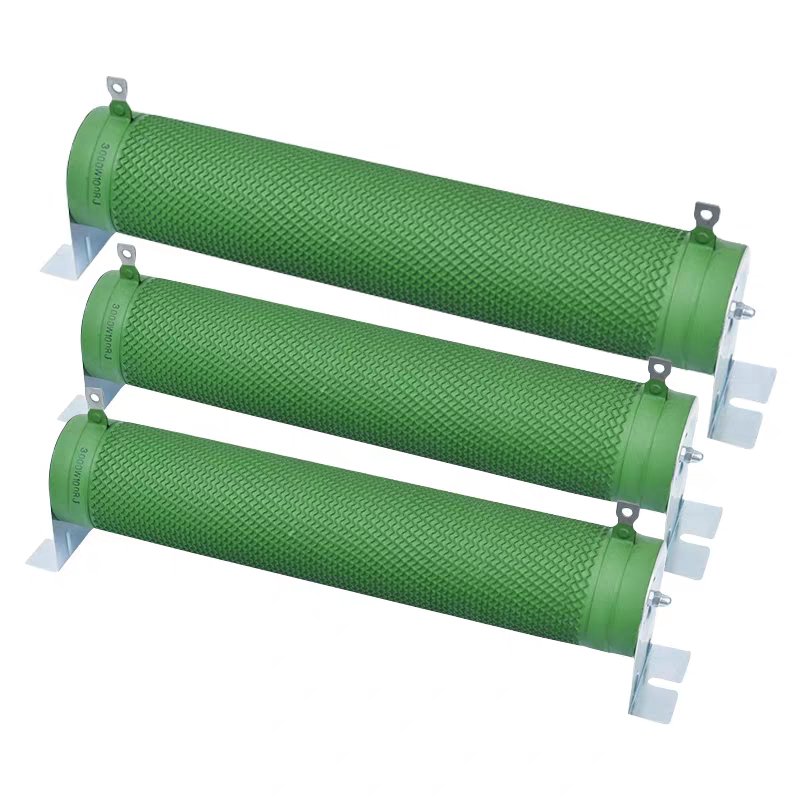
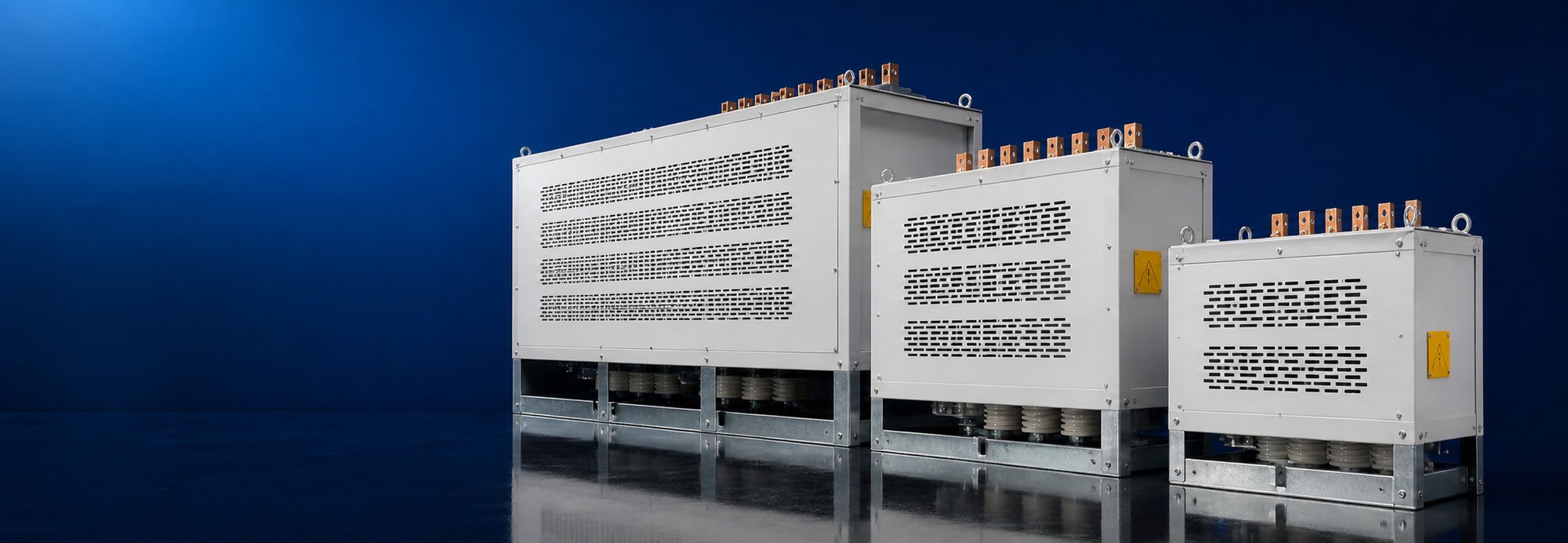
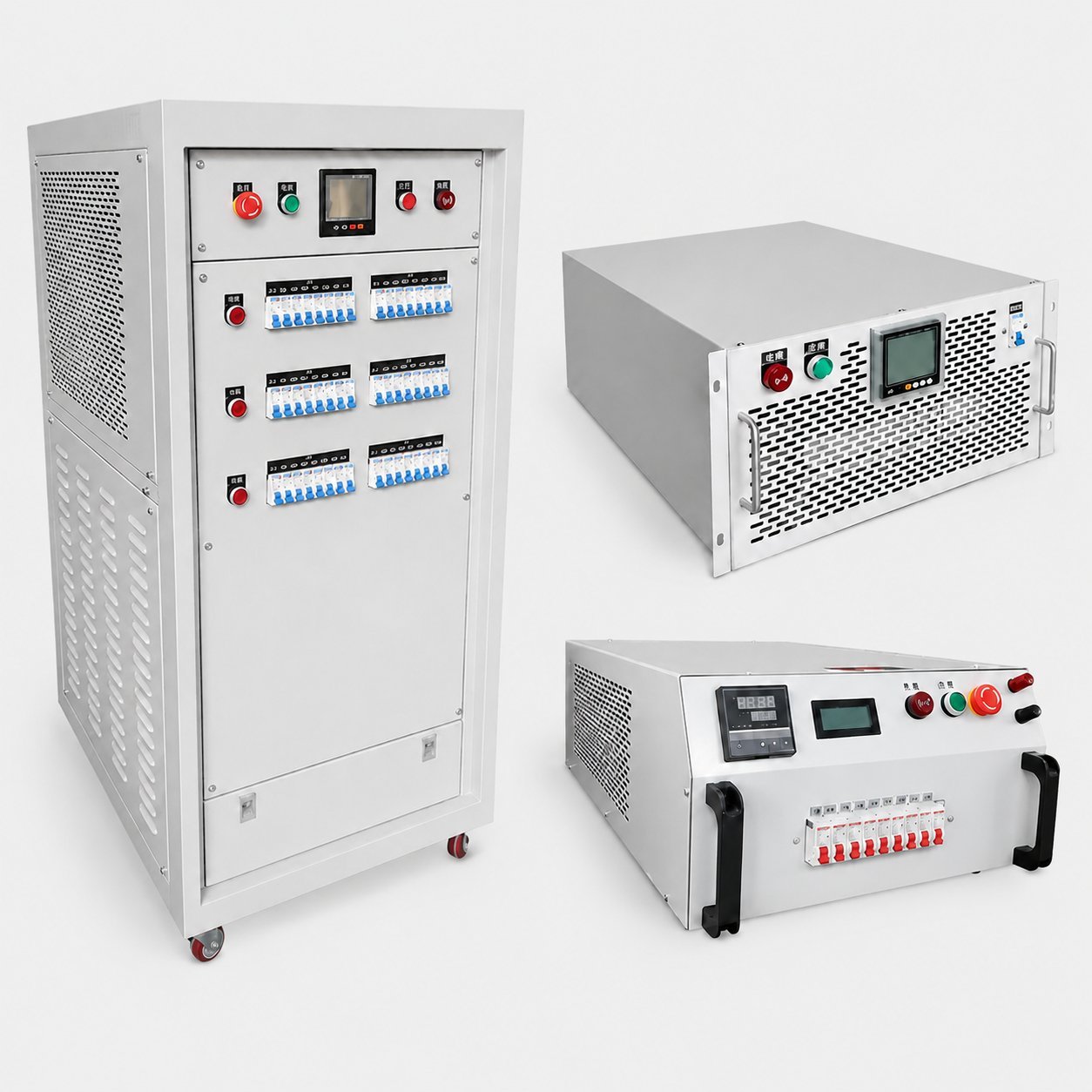
Hongyi load-bank cabinets ship in three standard families. All use the same wirewound element technology as our high-power braking resistor line, paired with a forced-air axial fan tray and PLC step control. Custom configurations are routine — kW step resolution, voltage class, IP rating and cam-lock series can all be specified at order entry.
- RB-50 / RB-100 / RB-200 (50 kW – 200 kW permanent rack-mount): 480 V or 400 V three-phase input, 5 kW step resolution, 19-inch cabinet form factor. See /products/resistor-box.
- RB-500 / RB-1M (500 kW – 1 MW forced-air wheeled portable): Painted-steel enclosure, integral cam-lock terminals, 10 kW resolution. Used at multi-site facility programs.
- Custom container-mount (1 MW – 5 MW combined R+L): 20-ft or 40-ft ISO container, integrated combined R + L bank, 0.8 PF lagging (selectable to 1.0), engineered ducting and exhaust hood. Quoted to spec.
For DC battery testing we configure the same cabinet families with DC contactors and step resistors — typical builds cover 24 V telecom strings, 48 V data-center DC, and 480 V UPS battery strings.
Final commissioning checklist
Before signing off the load-bank-installed test, confirm every line on this list. Skipping one of these items is the single most common reason a commissioning report fails third-party review.
- kW capacity at site ambient verified against the device-under-test nameplate plus 10 percent margin
- Power factor confirmed (resistive 1.0, combined 0.8 lag, or as specified)
- Step resolution and PLC sequence matches the test profile (NFPA 110, IEC 62040, IEEE 1188, or owner spec)
- Cabling sized for full continuous current at site ambient — not just at 25 °C standard
- Cooling air path clear, intake and exhaust temperatures monitored and logged
- Ground-fault trip threshold set to the facility's default (typically 30 mA for personnel, 100 mA for equipment)
- Cam-lock connections torqued to manufacturer spec, infrared scan performed at 50 percent load
- Test sequence documented with timestamped kW, kVA, voltage, current, frequency, exhaust temperature and fuel rate readings
- Post-test cool-down at 25 percent load for 5 minutes before shutdown to avoid hot-soak damage to bearings and turbocharger
- Battery strings receive equalising charge per IEEE 1188 if a DC test was performed
If you would like the Hongyi engineering team to spec a load bank for your specific application, share the device-under-test nameplate and test profile with info@resistor-factory.com — typical turnaround on a configured-to-order quote is one business day. Our standard cabinets ship in 4 to 6 weeks; custom container builds in 12 to 16 weeks.
常见问题
500 kW 备用发电机需要多大的负载箱?
柴油发电机已经每月在带真实负载运行了,为什么还要做负载箱测试?
选纯阻性还是阻感性混合负载箱?
UPS 电池放电测试通常需要多久?
调试期负载测试和日常负载测试有什么区别?
可以把多台小负载箱并联拼出更大功率吗?
参考资料与延伸阅读
- NFPA 110 — Standard for Emergency and Standby Power Systems
- IEEE Std 1188 — Recommended Practice for Maintenance, Testing and Replacement of VRLA Batteries
- IEC 62040-3 — UPS performance and test requirements
- ISO 8528-5 — Reciprocating internal combustion engine driven alternating current generating sets
- ASCO — Load Bank Utilization in Data Centers (white paper)
- Eaton — UPS load bank test scope of work (SOW L-6)
- Cummins — Application engineering: load bank testing