目次
Why you need a snubber resistor
Every hard-switched power converter contains parasitic inductance and capacitance that the schematic does not show: transformer leakage inductance, PCB-trace inductance, the IGBT or MOSFET output capacitance C_oss, the rectifier junction capacitance C_j, and the equivalent series inductance of the bus capacitor. The instant a switch turns off, the energy stored in those parasitics has nowhere quiet to go. It rings between the stray L and C at frequencies anywhere from 5 MHz to several hundred megahertz, producing voltage overshoots that routinely hit 1.5 to 2× the steady-state rail and EMI signatures that fail conducted-emission limits in CISPR 11 and CISPR 32.
A snubber resistor is the lossy element that takes the ringing energy out of the circuit. Pair it with a capacitor (RC snubber) and you get a critically damped second-order network: the snubber capacitor diverts the high-frequency current while the resistor dissipates the resonant energy. Pair it with a capacitor and a fast diode (RCD snubber or RCD clamp) and you get a one-shot voltage clamp that catches the leakage spike on a flyback transformer or on the high-side IGBT in a half-bridge.
In an IGBT half-bridge for a 1200 V drive, an unsnubbered turn-off transient will easily push the collector-emitter voltage to 1500 to 1700 V even though the DC link sits at 800 V. That is well above the cosmic-ray FIT-rate knee for most 1200 V devices and immediately above the absolute-maximum rating for many 1700 V parts. Infineon's snubber-considerations note documents real-world collector overshoot of dV/dt > 5 kV/µs in unsnubbered circuits and shows how a properly sized RC snubber drops both the peak voltage and the dV/dt by a factor of two or more (Infineon snubber application note).
The same parasitic ringing destroys output rectifier diodes in flyback and forward SMPS. When the secondary diode commutates off, the leakage inductance of the transformer pings against the diode's depletion-layer capacitance at typically 20 to 80 MHz; without a snubber the reverse voltage easily doubles, which accounts for a depressing fraction of returns from field-deployed power supplies. The four reasons engineers add a snubber, in priority order, are: (1) protecting the active switch from over-voltage, (2) protecting the rectifier diode from reverse-voltage breakdown, (3) reducing conducted EMI in the 30 MHz to 200 MHz band, and (4) reducing radiated EMI from the loop antenna formed by the switching node and the bus return.
Snubber types compared
Four families cover almost every snubber application in industrial and SMPS design. Each makes different trade-offs between energy handling, design complexity and dissipated power.
- RC snubber. A series resistor and capacitor placed across the switch or the diode. Simplest topology, dissipates roughly P = C×V²×f_sw every cycle regardless of whether ringing is present. Dominant choice for SMPS rectifier snubbing and for damping ringing across IGBT collector-emitter terminals at switching frequencies from 20 kHz to a few hundred kHz.
- RCD snubber (turn-off snubber). Resistor, capacitor and a fast recovery diode arranged so that the capacitor is charged through the diode at turn-off, then discharged through the resistor between switching events. Lower steady-state loss than an RC snubber because the capacitor only sees a current pulse during the transient. Used on hard-switched IGBT bridges from a few kW upward.
- Polarized RCD clamp. The defining topology for flyback transformer snubbing. Clamps the leakage-inductance spike on the primary side of a flyback, recycling some of the leakage energy back to the bus and burning the rest in the resistor. Cornell Dubilier's classic design paper by Rudy Severns is still the canonical reference (CDE Design of Snubbers for Power Circuits).
- Ferrite-bead damper. A lossy inductive bead in series with the switching node, sometimes paired with a small RC. Cheapest answer when the problem is purely high-frequency ringing above 50 MHz and the energy is small (a few hundred nanojoules per cycle). Common on synchronous-buck controllers below 25 A.
| Parameter | RC snubber | RCD turn-off | Polarized RCD clamp | Ferrite bead + RC |
|---|---|---|---|---|
| Typical energy per pulse | 10 nJ – 5 µJ | 100 µJ – 5 mJ | 1 mJ – 50 mJ | 10 nJ – 200 nJ |
| Resistor steady-state dissipation | ½ × C × V² × f_sw (always on) | Lower — pulsed discharge only | Leakage energy × f_sw | Negligible |
| Component count | 2 (R, C) | 3 (R, C, D) | 3 (R, C, D) | 2–3 |
| Design complexity | Low — closed-form formulas | Medium — diode trr matters | Medium-high — couples with transformer | Low |
| Relative cost | 1× | 1.3× | 1.5× | 0.5× |
| Typical use case | MOSFET drain ringing in flyback secondary, IGBT C–E ringing | Hard-switched IGBT half-bridge ≥ 5 kW | Flyback primary leakage clamp | Synchronous buck above 1 MHz, light loads |
| EMI improvement (typical) | 6–12 dB at ringing freq | 10–15 dB | 8–12 dB | 10–20 dB > 50 MHz |
The choice between RC and RCD usually comes down to thermal budget. An RC snubber dissipates a fixed energy per switching cycle whether or not there is anything to damp; on a 100 kHz converter that adds up to a continuous resistor load that can easily reach 5 to 20 W in a 5 kW drive. An RCD turn-off snubber only burns the energy that is actually present in the parasitics, which is usually three to five times lower for the same peak voltage clipping.
RC snubber design (with worked example)
The closed-form RC snubber design begins with the parasitic resonance you want to damp. Two unknowns characterise the parasitic loop: an effective inductance L_p (the trace and device package inductance plus any transformer leakage referred to the snubber loop) and an effective capacitance C_p (device output capacitance and PCB stray). Both are easy to extract by measurement.
Step 1: Measure the ringing frequency
With a 500 MHz scope and a sub-3 ns rise-time probe, capture the turn-off transient at the switch node. Read off the ringing period T_ring. Then add a known test capacitor C_t (typically 2 to 5 × the device C_oss) directly across the switch and measure the new ringing period T_ring2. The parasitic capacitance is then:
C_p = C_t / ((T_ring2 / T_ring)² - 1)
and the effective inductance is L_p = 1 / ((2πf_ring)² × C_p). This is the "two-frequency" method used in TI's classic seven-step procedure (TI Power Tips: Calculate an R-C Snubber in Seven Steps).
Step 2: Pick R for critical damping
The characteristic impedance of the parasitic tank is Z = √(L_p / C_p). Critical damping is reached at exactly that resistance:
R_snub = √(L_p / C_p)
Round to the nearest 5 % standard value. Going significantly below R_snub increases peak voltage; going significantly above leaves the ringing underdamped. Nexperia's AN11160 plots the family of damping curves and shows that the optimum is broad, typically ±30 %, so standard 5 % values are fine.
Step 3: Pick C for acceptable dissipation
Choose C_snub between 2 and 4 × C_p. Larger C gives more damping but more steady-state loss; smaller C only damps the first few cycles. The continuous power burned in the snubber resistor is:
P_R = C_snub × V_sw² × f_sw
where V_sw is the switching-node voltage swing. This power is independent of R for a given C and frequency, which surprises many engineers — the resistor controls damping, the capacitor controls loss.
Step 4: Verify pulse stress
During each turn-off, the snubber resistor briefly sees a current pulse equal to the diverted ringing current. Peak power for a few hundred nanoseconds is frequently 50 to 200 × the average rating, which is why pulse-energy capacity matters even on a snubber that only dissipates a few watts on average.
Worked example: 1200 V / 100 A IGBT half-bridge at 20 kHz
A 75 kW solar inverter half-bridge runs from an 800 V DC link with two 1200 V / 150 A IGBT modules. The customer reports collector overshoots of 1450 V on a thermal cabinet test. Scope measurements at the collector show a 28 MHz ringing frequency. We add C_t = 2.2 nF across the collector-emitter terminals and the ringing drops to 12 MHz.
- Parasitic capacitance: C_p = 2.2 nF / ((28/12)² - 1) = 2.2 / 4.44 = 495 pF.
- Parasitic inductance: L_p = 1 / ((2π × 28 MHz)² × 495 pF) = 65 nH — typical for a busbar plus module-package loop.
- Snubber resistor for critical damping: R = √(65 nH / 495 pF) = 11.5 Ω. Pick the closest E12 value: 12 Ω.
- Snubber capacitor: C = 3 × 495 pF = 1.5 nF, with 2 kV DC rating per IEC 60384-14.
- Continuous power: P_R = 1.5 nF × 800² × 20 kHz = 19.2 W. Plus a 1.4 safety factor and we need a 30 W non-inductive snubber resistor.
- Peak pulse power: the snubber capacitor discharges through R in roughly 3 × R×C = 54 ns, with a peak current of V/R = 800 / 12 = 67 A. Peak instantaneous power = V²/R = 53 kW for ~50 ns. Energy per pulse = ½ C V² = 0.48 mJ — well within the pulse capacity of any cement-cased non-inductive part rated 30 W or more.
The same procedure applies to MOSFET drain snubbers and to flyback secondary rectifier snubbers — only the parasitics change. For the rectifier-snubber case, C_p is dominated by the diode junction capacitance and L_p by the secondary leakage referred to the diode loop; the formulas are identical.
Why non-inductive winding matters
A standard wirewound resistor is constructed by spiral-winding nichrome or Cu-Ni wire onto a ceramic former. The geometry is electrically identical to a single-layer solenoid: every turn adds inductance proportional to the square of the turn count. A 25 W tubular wirewound at 22 Ω can have a self-inductance of 3 to 8 µH — at 28 MHz that is an inductive reactance of roughly 500 to 1400 Ω, totally swamping the resistive part and inverting the snubber's behaviour.
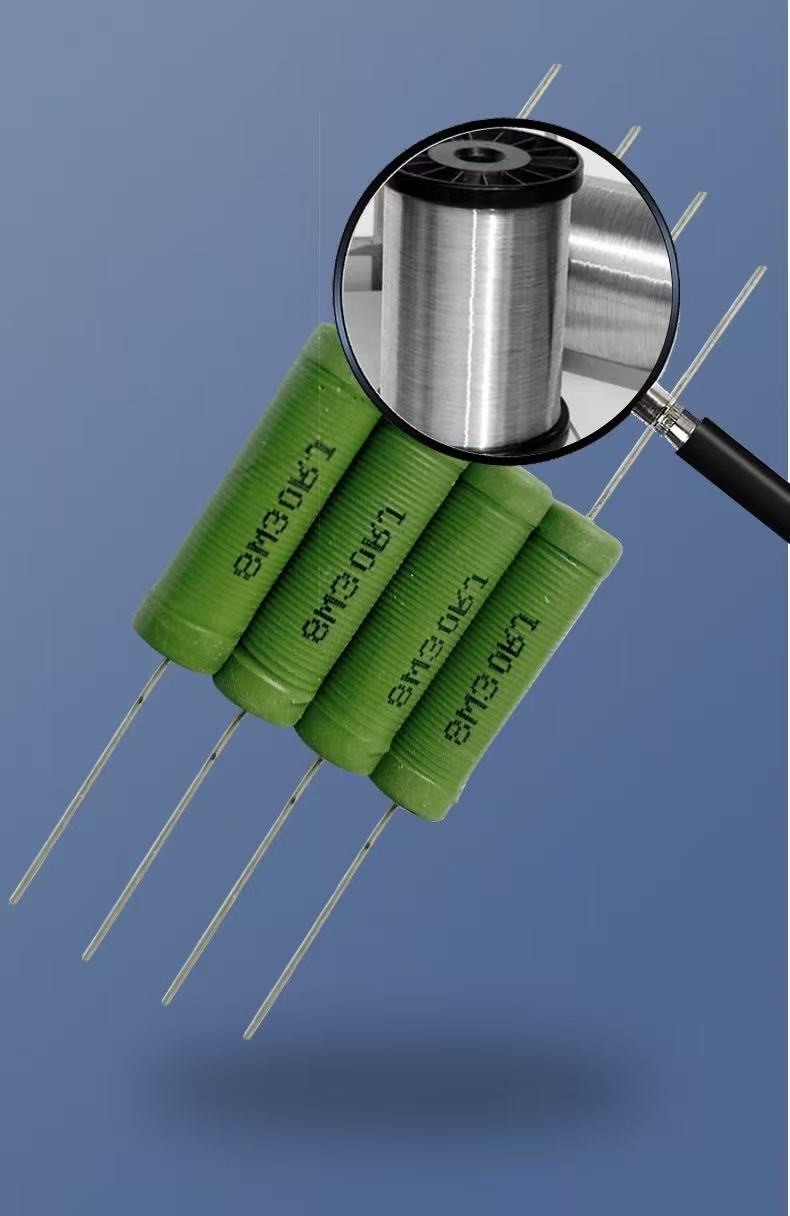
The fix is to wind the wire in a way that cancels its own magnetic flux. Two mainstream techniques are used in the industry:
- Bifilar winding. The resistance wire is folded in half and the two halves are wound together as a parallel pair. Adjacent turns carry equal and opposite currents, so the magnetic fields cancel almost completely. Residual inductance is dominated by the small loop at the fold, typically 0.05 to 0.2 µH per ohm of resistance value.
- Ayrton-Perry winding. Two windings are placed concentrically around the same former, wound in opposite helices and connected in parallel. Cancels both inductance and a portion of the capacitance, achieving residual inductances under 0.05 µH even in 50 W tubular formats. Used by precision suppliers including Vishay's MRA and NS series.
The practical engineering target for a snubber resistor is residual inductance under 0.1 µH. At that level the inductive reactance at 30 MHz is about 19 Ω — small compared with the typical 5 to 50 Ω snubber resistance and small enough not to alter the damping time constant by more than a few percent.
The effect of a poorly chosen resistor is dramatic and easy to demonstrate. Drop a standard 22 Ω / 25 W tubular wirewound into the worked example above and the "snubber" will actually increase the ringing amplitude because the resistor has become an inductor in series with the snubber capacitor, forming a third resonant tank instead of the intended R-C damper. Bench measurements at our application lab show 1.2 × to 1.4 × worse overshoot with inductive parts in 100 kHz to 1 MHz circuits, with the failure mode getting worse as switching frequency rises.
Pulse-power capacity vs continuous rating
A snubber resistor's continuous wattage and its single-pulse joule rating are completely separate specifications and they are limited by different physics. The continuous rating is set by the steady-state thermal path from the resistance element through the housing to ambient air. The single-pulse rating is set by the element's heat capacity — how much energy can be absorbed before the wire reaches its maximum allowed instantaneous temperature.
For pulses shorter than the resistor's thermal time constant (typically 10 to 100 ms for cement-cased and aluminum-housed parts), the cement or alloy body acts as a heat sink and the wire only rises in temperature by the energy divided by the wire's heat capacity. A 5 W cement resistor with about 0.5 g of nichrome wire can absorb roughly 50 J in a single sub-millisecond pulse and keep the wire below 350 °C — without exceeding the steady-state rating for more than a few hundred microseconds.
A second effect that matters specifically for snubber duty is skin effect. At 30 MHz the skin depth in nichrome is about 30 µm, which is smaller than the diameter of the wire used in any wirewound rated above 1 W. The effective AC resistance rises and the current crowds onto the surface of the wire, increasing local heating. For snubber applications this means a derating of 10 to 20 % of pulse capacity above 10 MHz compared with the DC pulse rating.
| Parameter | Form factor | Continuous P | Single 1 ms pulse | Single 100 µs pulse | Repetitive (20 kHz) |
|---|---|---|---|---|---|
| 0805 thick film | 0.125 W | 5 J/g × 0.001 g ≈ 5 mJ | 5 mJ | 0.1 W | |
| Axial metal-oxide 2 W | 2 W | 150 mJ | 200 mJ | 1.5 W | |
| Cement SQP 5 W (NI) | 5 W | 50 J | 20 J | 5 W | |
| Cement SQP 10 W (NI) | 10 W | 120 J | 40 J | 10 W | |
| Aluminum housed 25 W (NI) | 25 W with HS | 300 J | 100 J | 20 W (no HS) | |
| Tubular wirewound 50 W (NI) | 50 W | 1.5 kJ | 400 J | 40 W | |
| Tubular wirewound 200 W (NI) | 200 W | 8 kJ | 2 kJ | 180 W |
The takeaway: a snubber resistor is sized first by continuous dissipation (P_R = C×V²×f_sw), then verified against single-pulse capacity. The continuous number nearly always dominates for switching frequencies above a few kHz, but for low-frequency surge applications (line-frequency triac or thyristor snubbers, 50 to 60 Hz) the pulse spec dominates because the resistor sees only 100 to 120 events per second and most of its time is spent cooling.
Choosing the right resistor type
Five resistor families realistically compete for snubber duty. The right pick depends on the steady-state power, the per-pulse energy, the switching frequency and whether the resistor has to be PCB-mounted or chassis-mounted.
- Carbon composition. The original snubber resistor — naturally non-inductive because the conductive element is bulk carbon, not wound wire. Available up to 2 W. Excellent pulse-to-continuous ratio. Drift under humidity and aging is poor (5 to 10 % over a few thousand hours), so avoid in resistance-critical loops. Good for low-power snubbers in vintage and aerospace designs.
- Carbon film. Spiral-cut carbon film resistors are inductive and should be avoided in snubbers. Non-spiralled carbon film up to 1 W is acceptable below 10 MHz.
- Metal film / metal oxide. Inherently low-inductance because the resistive element is a thin film. Metal-oxide film handles 2 to 5 W with excellent surge tolerance — Vishay's PR02-FS is a 2 W film part specifically positioned for snubber duty.
- Cement-encased non-inductive wirewound. The workhorse for SMPS and IGBT snubbers from 5 W to 50 W. Bifilar winding inside a mineral-cement body. Pulse capacity 5 to 20 × continuous rating. Cost per watt is the lowest of any non-inductive technology.
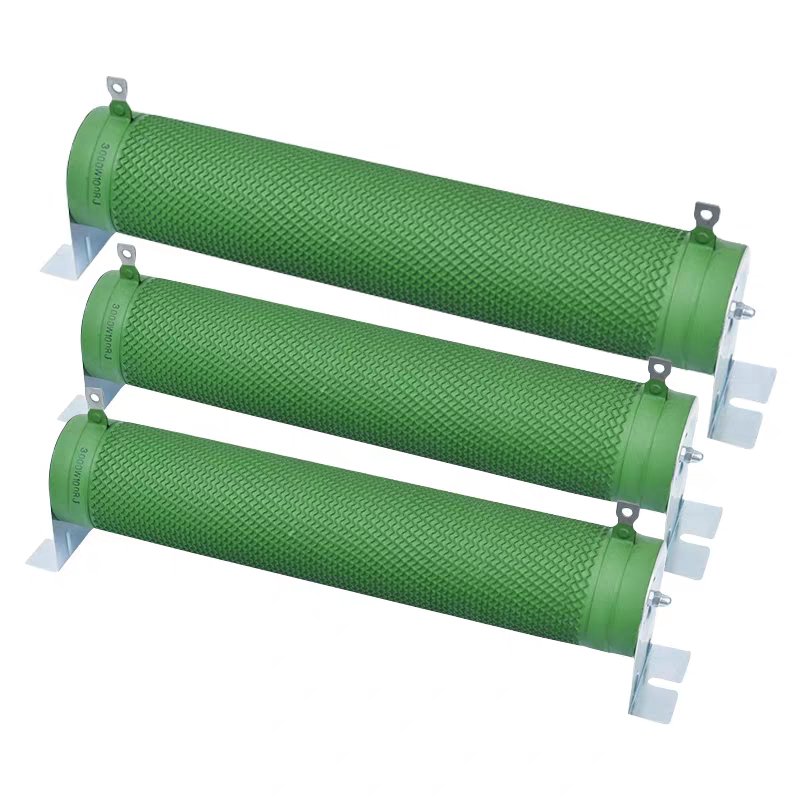
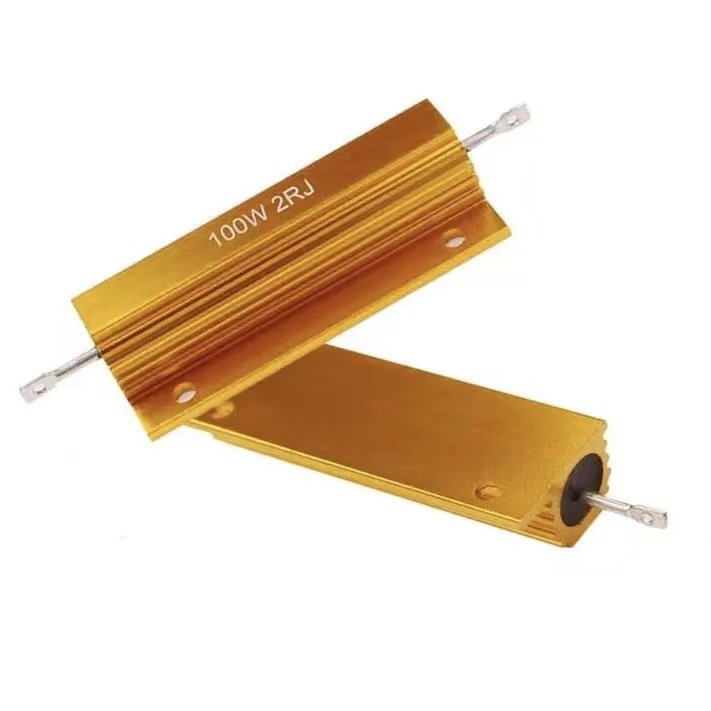
- Aluminum-housed non-inductive wirewound. 25 to 1000 W for chassis-mount snubbers in larger drives, induction heaters and traction choppers. Bolts to a heatsink so continuous rating climbs sharply with proper mounting.
Two practical notes. First, the snubber capacitor must be rated for continuous high-frequency current — IEC 60384-14 X- and Y-class film capacitors or specific snubber-rated polypropylene parts. A general-purpose ceramic disc rated for DC will fail in weeks under continuous AC ripple of several amps RMS. Second, lead length matters as much as the resistor itself: a 10 mm leg adds about 10 nH each side, which is 4 Ω reactance at 60 MHz. Mount snubber resistors with the shortest possible leads and prefer surface-mount bend-leg or tab-terminated parts in PCB designs.
Common mistakes & failure modes
We see the same five engineering mistakes repeatedly in snubber designs that come back as field-return investigations. Each is preventable.
Mistake 1 — Wrong resistance value triggers resonance
Picking R far below the critical-damping value makes the circuit underdamped: the new RC snubber forms a third tank with the parasitic L and you get higher peak voltage, not lower. Picking R far above critical leaves the original ringing almost unchanged. Always start from R = √(L_p/C_p) and round to a standard value within ±30 %.
Mistake 2 — Inductive resistor causing more ringing than the original
The most common silent failure. The snubber goes in, EMI gets worse, the engineer concludes "snubbers don't help at this frequency" and removes it. The actual fix is to swap the standard wirewound for a non-inductive part. Insist on a residual-inductance number on the supplier datasheet — "low inductance" with no number is meaningless.
Mistake 3 — Undersized continuous power rating
Engineers often size the snubber resistor on the visible pulse current and forget that for an RC snubber, the resistor dissipates C×V²×f_sw continuously. On a 100 kHz / 600 V converter with a 4.7 nF snubber, that is 1.7 W — a 1 W part will run hot enough to fail in months. Always compute the continuous loss and apply at least a 1.5 derating.
Mistake 4 — Lead inductance dominates above 100 kHz
On a through-hole snubber-cap with 10 mm leads on each side, the parasitic inductance contribution is roughly 20 nH. At 100 MHz that is 12 Ω of pure reactance — comparable to or larger than the snubber resistor itself. Use SMD or tab-terminated parts and keep the snubber loop area under 50 mm² for switching frequencies above a few hundred kHz.
Mistake 5 — Wrong capacitor dielectric
High-K ceramics (X7R, Y5V) lose 50 to 80 % of their capacitance under DC bias and at high temperature. The snubber that worked on the bench at room temperature with no bias will fail validation testing at 105 °C. Use C0G/NP0 ceramic up to 4.7 nF; metallised polypropylene above that. IEC 60384-14 X-class film is the safe default for AC-line snubbers.
Hongyi product recommendations
Hongyi Electronics manufactures non-inductive variants of every product family mentioned above. A short cross-reference for snubber-resistor selection:
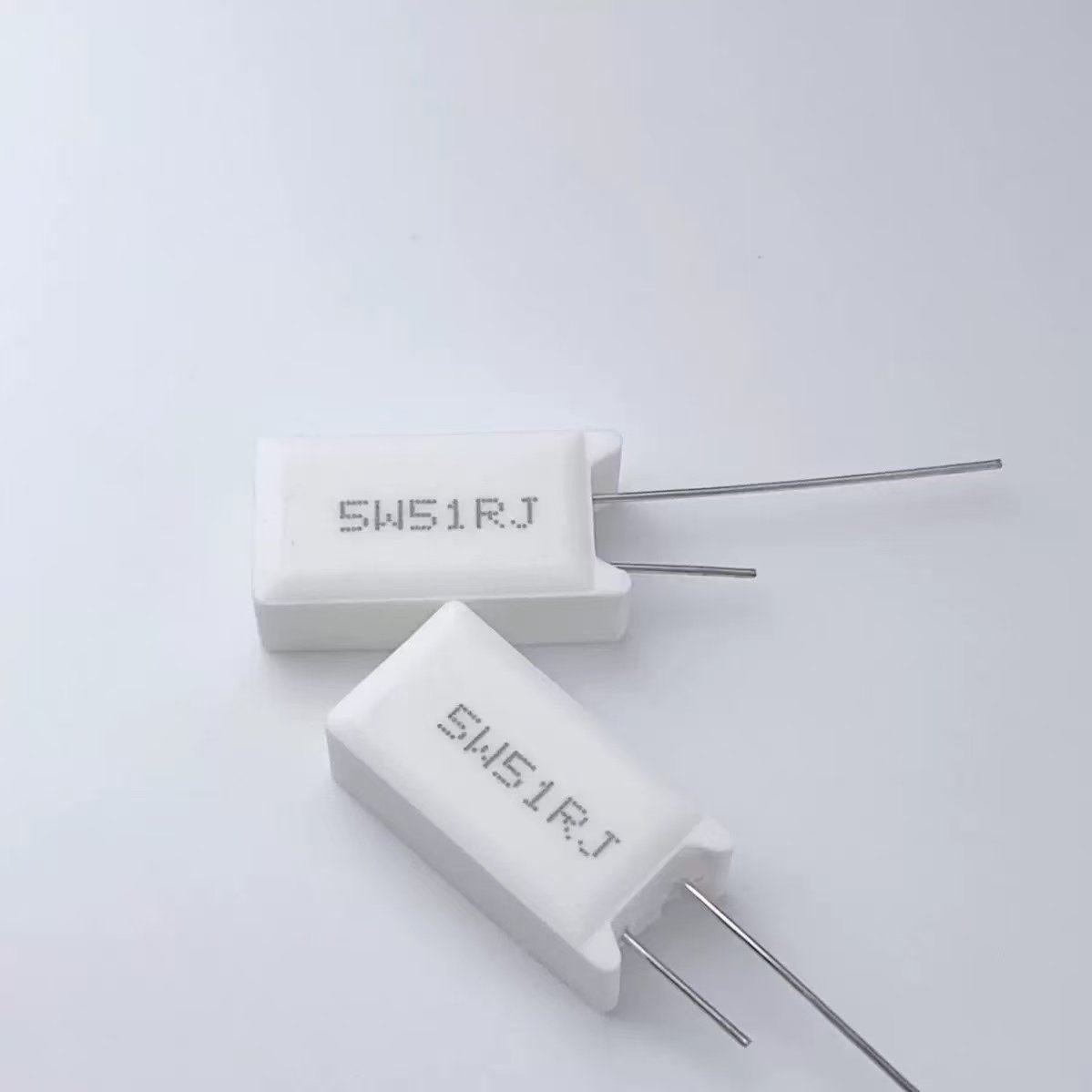
- Cement-encased non-inductive (SQP-NI series). 5 W to 50 W, bifilar wound, residual inductance < 0.1 µH. The default choice for SMPS rectifier snubbers and IGBT C-E snubbers in drives up to 50 kW. See the cement resistor family for full specs and resistance ranges.
- Aluminum-housed non-inductive (RX24-NI series). 25 W to 300 W with proper heatsinking. For larger inverters, induction heaters and traction choppers where chassis mount and forced cooling are available.
- Tubular wirewound non-inductive (RXLG-NI series). 100 W to 2000 W per element for high-power dump, RCD-clamp resistor strings and snubber banks in MW-scale drives. Browse the full wirewound resistor family for tubular and corrugated formats.
All non-inductive variants are produced to IEC 60115-1 for the resistive element and to IEC 60068-2 environmental tests for cement and aluminum housings. Hongyi publishes residual-inductance figures on each datasheet — never an unqualified "non-inductive" claim. For high-volume IGBT-module customers we also offer custom tab-terminated formats, bus-bar mounted snubber assemblies and matched-pair selections within ±1 % of nominal resistance for parallel snubber strings.
よくある質問
RC スナバ回路に使う抵抗値はどう決めますか?
なぜ通常の巻線抵抗ではリンギングが悪化するのですか?
スナバ抵抗の連続定格電力はどう算出しますか?
通常の RC ではなく RCD スナバを使うべきなのはどんな時ですか?
無誘導スナバ抵抗の残留インダクタンスはどの程度を目安にすべきですか?
スナバ容量に高誘電率セラミックコンデンサを使えますか?
参考文献・関連リンク
- Infineon — Snubber Considerations for IGBT Applications
- TI Power Tips — Calculate an R-C Snubber in Seven Steps
- Cornell Dubilier — Design of Snubbers for Power Circuits (Severns)
- Nexperia AN11160 — Designing RC snubbers
- Vishay MRA — Non-magnetic, non-inductive wirewound resistor datasheet
- IEC 60115-1 — Fixed resistors for use in electronic equipment
- IEC 60384-14 — Fixed capacitors for EMI suppression and connection to the supply mains